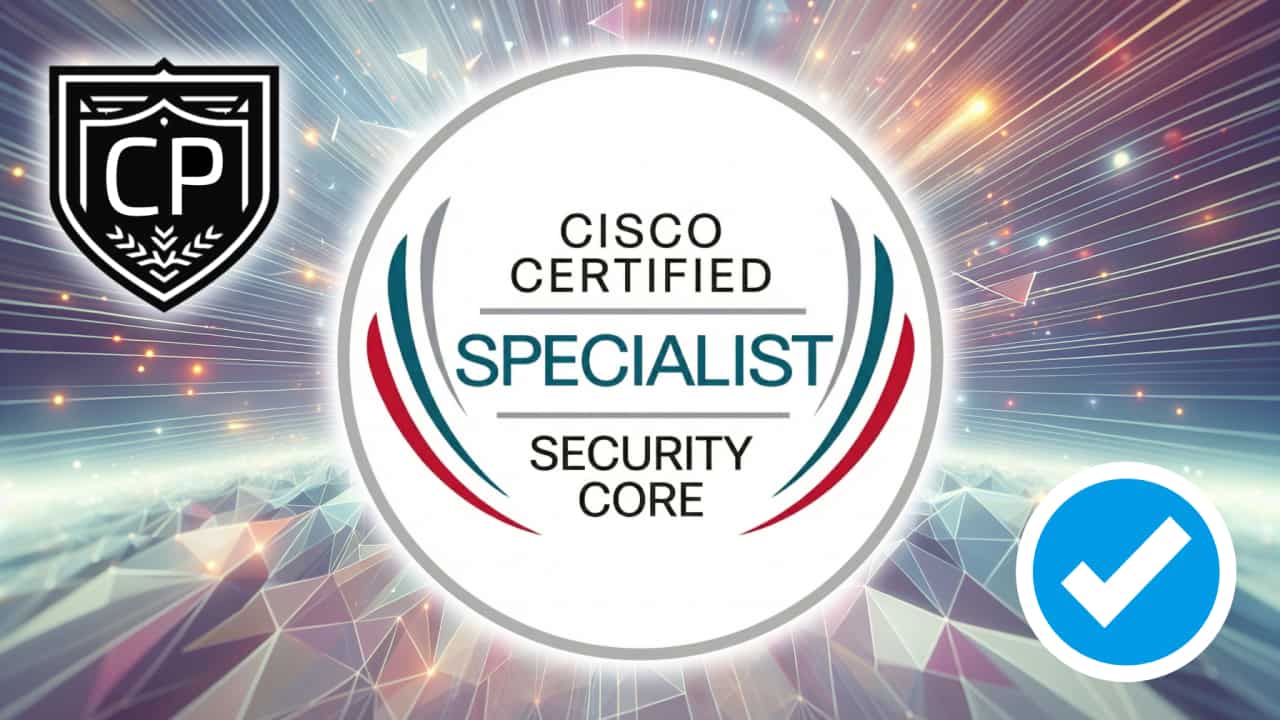
Cisco Certified Specialist Security Core Quick Facts (2025)

Comprehensive overview to help you pass the Cisco Certified Specialist – Security Core (350-701 SCOR) exam, covering domains, exam details, study strategies, hands-on labs, and key Cisco security technologies like Secure Firewall, Umbrella, Secure Endpoint, and analytics.

Cisco Certified Specialist Security Core Quick Facts
5 min read
Cisco Certified Specialist Security Core350-701 SCORSCOR examSCOR v1.1Cisco 350-701
Table of Contents

Cisco Certified Specialist Security Core Quick Facts

The Cisco Certified Specialist Security Core certification empowers IT security professionals to build deeper expertise in network defense, secure access, and modern threat protection. This overview gives you everything you need to feel prepared and confident as you explore the core blueprint of Cisco’s advanced security specialization.

Exploring the Purpose and Power of the Cisco Certified Specialist Security Core Certification

This certification validates your ability to implement and manage Cisco security technologies across complex environments. It’s designed for security engineers, network specialists, and professionals aiming to expand their technical mastery in protecting hybrid infrastructures through Cisco’s secure architecture. The credential demonstrates readiness to deploy advanced security solutions that reinforce visibility, control, and resilience across today’s dynamic enterprise networks.

Exam Domains Covered (Click to expand breakdown)

Exam Domain Breakdown

Domain 1: Security Concepts (25% of the exam)

Security Concepts

  • Explain common threats against on-premises, hybrid, and cloud environments — On-premises: viruses, trojans, DoS/DDoS attacks, phishing, rootkits, man-in-the-middle attacks, SQL injection, cross-site scripting, malware
  • Explain common threats against on-premises, hybrid, and cloud environments — Cloud: data breaches, insecure APIs, DoS/DDoS, compromised credentials
  • Compare common security vulnerabilities such as software bugs, weak and/or hardcoded passwords, OWASP top ten, missing encryption ciphers, buffer overflow, path traversal, cross-site scripting/forgery
  • Describe functions of the cryptography components such as hashing, encryption, PKI, SSL, IPsec, NAT-T IPv4 for IPsec, preshared key, and certificate-based authorization
  • Compare site-to-site and remote access VPN deployment types and components such as virtual tunnel interfaces, standards-based IPsec, DMVPN, FlexVPN, and Cisco Secure Client including high availability considerations
  • Describe security intelligence authoring, sharing, and consumption
  • Describe the controls used to protect against phishing and social engineering attacks
  • Explain North Bound and South Bound APIs in the SDN architecture
  • Explain Cisco DNA Center APIs for network provisioning, optimization, monitoring, and troubleshooting
  • Interpret basic Python scripts used to call Cisco Security appliances APIs

Security Concepts summary:
This section builds a solid foundation in understanding threats, vulnerabilities, cryptography, and secure connectivity. You will explore how to identify attack vectors across on-premises, hybrid, and cloud systems, and see how security intelligence and automation connect the dots for faster, smarter defense. Understanding cryptography components such as PKI and SSL provides the base for encryption and authentication strategies crucial to every secure network.

Additionally, the section emphasizes Cisco’s integrated approach through APIs and automation. You will learn how programmable interfaces in Cisco DNA Center and Python scripting simplify provisioning, enhance monitoring, and extend automation for greater security agility. The knowledge gained here ensures you can balance strong theoretical understanding with practical control using Cisco’s modern tools and secure architecture principles.


Domain 2: Network Security (20% of the exam)

Network Security

  • Compare network security solutions that provide intrusion prevention and firewall capabilities
  • Describe deployment models of network security solutions and architectures that provide intrusion prevention and firewall capabilities
  • Describe the components, capabilities, and benefits of NetFlow and Flexible NetFlow records
  • Configure and verify network infrastructure security methods — Layer 2 methods (network segmentation using VLANs; Layer 2 and port security; DHCP snooping; Dynamic ARP inspection; storm control; PVLANs to segregate network traffic; and defenses against MAC, ARP, VLAN hopping, STP, and DHCP rogue attacks)
  • Configure and verify network infrastructure security methods — Device hardening of network infrastructure security devices (control plane, data plane, and management plane)
  • Implement segmentation, access control policies, AVC, URL filtering, malware protection, and intrusion policies
  • Implement management options for network security solutions (single vs. multidevice manager, in-band vs. out-of-band, cloud vs. on-premises)
  • Configure AAA for device and network access such as TACACS+ and RADIUS
  • Configure secure network management of perimeter security and infrastructure devices such as SNMPv3, NetConf, RestConf, APIs, secure syslog, and NTP with authentication
  • Configure and verify site-to-site and remote access VPN — Site-to-site VPN using Cisco routers and IOS
  • Configure and verify site-to-site and remote access VPN — Remote access VPN using Cisco AnyConnect Secure Mobility client
  • Configure and verify site-to-site and remote access VPN — Debug commands to view IPsec tunnel establishment and troubleshooting

Network Security summary:
This section dives into the applied components of network protection, covering firewalls, intrusion prevention, and traffic security at every layer. You’ll explore how architectures leverage NetFlow analytics to maintain visibility and how Cisco solutions ensure segmentation and access are properly enforced. By mastering device hardening and Layer 2 protections, you enhance your ability to defend against network-level threats and unauthorized activity with confidence.

The second part focuses on secure connectivity and management. You will configure and validate VPN solutions, AAA services, and secure communication protocols that safeguard infrastructure and endpoints. Through practical tasks, you develop the skills to maintain reliable, efficient, and secure network operations in multi-layered environments powered by Cisco’s technologies.


Domain 3: Securing the Cloud (15% of the exam)

Securing the Cloud

  • Identify security solutions for cloud environments — Public, private, hybrid, and community clouds
  • Identify security solutions for cloud environments — Cloud service models: SaaS, PaaS, IaaS (NIST 800-145)
  • Compare security responsibility for the different cloud service models — Patch management in the cloud
  • Compare security responsibility for the different cloud service models — Security assessment in the cloud
  • Describe the concept of DevSecOps (CI/CD pipeline, container orchestration, and secure software development)
  • Implement application and data security in cloud environments
  • Identify security capabilities, deployment models, and policy management to secure the cloud
  • Configure cloud logging and monitoring methodologies
  • Describe application and workload security concepts

Securing the Cloud summary:
This section highlights how to extend security architectures across cloud models and service types. You’ll review the responsibilities within SaaS, PaaS, and IaaS offerings and learn to apply appropriate security practices for each. Mastering visibility, patching, and configuration consistency becomes central as you adapt traditional controls to the shared responsibility of the cloud environment.

A key focus is on DevSecOps and continuous security integration. Through practical examples and conceptual understanding, you’ll see how secure coding, container orchestration, and automated policy enforcement help protect evolving applications. You also gain clarity on monitoring, policy management, and workload protection techniques that bring secure design from the data center into dynamic cloud topologies.


Domain 4: Content Security (15% of the exam)

Content Security

  • Implement traffic redirection and capture methods for web proxy
  • Describe web proxy identity and authentication including transparent user identification
  • Compare the components, capabilities, and benefits of on-premises, hybrid, and cloudbased email and web solutions (Cisco Secure Email Gateway, Cisco Secure Email Cloud Gateway, and Cisco Secure Web Appliance)
  • Configure and verify web and email security deployment methods to protect onpremises, hybrid, and remote users
  • Configure and verify email security features such as SPAM filtering, antimalware filtering, DLP, blocklisting, and email encryption
  • Configure and verify Cisco Umbrella Secure Internet Gateway and web security features such as blocklisting, URL filtering, malware scanning, URL categorization, web application filtering, and TLS decryption
  • Describe the components, capabilities, and benefits of Cisco Umbrella
  • Configure and verify web security controls on Cisco Umbrella (identities, URL content settings, destination lists, and reporting)

Content Security summary:
This section develops mastery over web and email protection mechanisms, teaching how Cisco’s platforms work collectively to secure content across all user environments. You’ll explore deployment designs from on-premises to cloud, applying Cisco Secure Email and Web Appliance features to intercept and disinfect threats before they reach the endpoint.

The domain extends into proactive defense with Cisco Umbrella, emphasizing content filtering, category-based controls, and encrypted traffic analysis. You’ll apply configuration and verification best practices to align access and identity policies, ensuring that every layer of content exchange remains trusted, authenticated, and monitored for potential compromise.


Domain 5: Endpoint Protection and Detection (10% of the exam)

Endpoint Protection and Detection

  • Compare Endpoint Protection Platforms (EPP) and Endpoint Detection & Response (EDR) solutions
  • Configure endpoint antimalware protection using Cisco Secure Endpoint
  • Configure and verify outbreak control and quarantines to limit infection
  • Describe justifications for endpoint-based security
  • Describe the value of endpoint device management and asset inventory systems such as MDM
  • Describe the uses and importance of a multifactor authentication (MFA) strategy
  • Describe endpoint posture assessment solutions to ensure endpoint security
  • Explain the importance of an endpoint patching strategy

Endpoint Protection and Detection summary:
This section focuses on securing the last line of defense: the endpoint. You’ll compare EPP and EDR strategies and configure Cisco Secure Endpoint to identify and stop suspicious activity in real time. The section also covers outbreak control and quarantine techniques that contain infections, supporting strong incident containment processes.

Equally important is the emphasis on policy and posture. You will see how mobile device management and MFA solutions strengthen identity assurance and compliance. By integrating patching, posture assessment, and rapid remediation, you can create an environment where each device contributes to the wider security posture of the network.


Domain 6: Secure Network Access, Visibility, and Enforcement (15% of the exam)

Secure Network Access, Visibility, and Enforcement

  • Describe identity management and secure network access concepts such as guest services, profiling, posture assessment and BYOD
  • Configure and verify network access control mechanisms such as 802.1X, MAB, WebAuth
  • Describe network access with CoA
  • Describe the benefits of device compliance and application control
  • Explain exfiltration techniques (DNS tunneling, HTTPS, email, FTP/SSH/SCP/SFTP, ICMP, Messenger, IRC, NTP)
  • Describe the benefits of network telemetry
  • Describe the components, capabilities, and benefits of these security products and solutions — Cisco Secure Network Analytics
  • Describe the components, capabilities, and benefits of these security products and solutions — Cisco Secure Cloud Analytics
  • Describe the components, capabilities, and benefits of these security products and solutions — Cisco pxGrid
  • Describe the components, capabilities, and benefits of these security products and solutions — Cisco Umbrella Investigate
  • Describe the components, capabilities, and benefits of these security products and solutions — Cisco Cognitive Intelligence
  • Describe the components, capabilities, and benefits of these security products and solutions — Cisco Encrypted Traffic Analytics
  • Describe the components, capabilities, and benefits of these security products and solutions — Cisco Secure Client Network Visibility Module (NVM)

Secure Network Access, Visibility, and Enforcement summary:
This section ties together identity management, access control, and telemetry into one cohesive view of secure network operations. You’ll configure methods such as 802.1X and MAB to authenticate users and maintain secure access while leveraging policies that adapt based on posture and compliance. The goal is to ensure every user and device entering the network meets established security standards.

Furthermore, the focus on analytics solutions reinforces total visibility. You’ll explore Cisco Secure Network Analytics, pxGrid, and related telemetry platforms to track activity, detect anomalies, and improve network enforcement. Understanding exfiltration patterns and integrating Cisco’s analytics solutions enable you to anticipate risks and act decisively, ensuring that your network not only stays protected but grows more intelligent with each interaction.

Who Should Earn the Cisco Certified Specialist – Security Core Certification?

The Cisco Certified Specialist – Security Core (350-701 SCOR) certification is tailored for professionals who want to strengthen their expertise in protecting enterprise networks, cloud environments, and endpoints against modern security threats. It’s ideal for:

  • Network and Security Engineers aiming to advance their cybersecurity skill set
  • IT professionals pursuing the CCNP Security or CCIE Security certifications
  • Security Specialists managing hybrid IT infrastructures
  • System Administrators responsible for secure access and visibility tools
  • Consultants or solutions architects focusing on Cisco security technologies

This certification allows you to demonstrate your technical excellence with Cisco’s leading security portfolio, setting you apart as a trusted network defender.

What Can This Cisco Security Core Certification Do for My Career?

Achieving the Security Core certification opens doors to advanced roles in network and cybersecurity disciplines. With this credential, you can pursue positions such as:

  • Network Security Engineer
  • Security Operations Center (SOC) Analyst
  • Cybersecurity Engineer
  • Cloud Security Specialist
  • Security Consultant
  • Network Architect

For those on a certification pathway, the 350-701 SCOR also meets the core exam requirement for both the CCNP Security and CCIE Security certifications, helping you climb Cisco’s professional certification ladder.

What Version of the SCOR Exam Should I Take?

The current version is Implementing and Operating Cisco Security Core Technologies (350-701 SCOR v1.1). This version aligns with the latest Cisco ecosystem, emphasizing modern security principles across on-premises, cloud, and hybrid environments. Always ensure your study resources are aligned with this version to maximize your preparation efficiency.

How Long Is the SCOR Exam and How Is It Structured?

The SCOR exam lasts 120 minutes, providing enough time to evaluate your real-world knowledge of Cisco’s security technologies. You will encounter approximately 110 questions, including multiple-choice and multi-select items. The test may also include simulated scenarios that require strategic thinking across network, cloud, and endpoint domains.

What Is the Passing Score for the 350-701 SCOR Exam?

To earn the Cisco Certified Specialist – Security Core credential, you’ll need a passing score of 83. The exam uses a scaled scoring model to provide a balanced assessment of your overall understanding. This ensures that mastery of key concepts like VPNs, network segmentation, and cloud security is rewarded, even if some topics are stronger than others.

How Much Does the Cisco Security Core Exam Cost?

The cost of the exam is $400 USD. You can also pay with Cisco Learning Credits through your employer or organization. This investment not only validates your technical expertise but also enhances your professional credibility as a Cisco-certified security specialist.

In What Languages Is the 350-701 SCOR Exam Offered?

This certification exam is available in English and Japanese, ensuring accessibility to a wide range of global candidates. Cisco continually updates its language offerings based on demand, so always double-check during registration if your preferred language is supported.

How Many Domains Make Up the Cisco Security Core Certification?

The exam blueprint covers six key domains, each representing an integral layer of Cisco’s security architecture:

  1. Security Concepts (25%)
  2. Network Security (20%)
  3. Securing the Cloud (15%)
  4. Content Security (15%)
  5. Endpoint Protection and Detection (10%)
  6. Secure Network Access, Visibility, and Enforcement (15%)

Together, these domains test your ability to integrate, operate, and defend across complex network environments.

What Knowledge Areas Should I Focus On to Pass the Cisco Security Core Exam?

Concentrate on these major areas to ensure success:

  1. Core Security Principles – Threat types, vulnerabilities, and cryptography
  2. Cisco Network Protection – Firewalls, intrusion prevention, and segmentation
  3. Cloud Infrastructure Defense – Cloud models, DevSecOps, secure workload management
  4. Content Filtering and Protection – Web proxy setup, email security, malware defense
  5. Endpoint Security – EPP vs. EDR, antivirus management, and posture assessment
  6. Secure Access Control – 802.1X, CoA, profiling, and network telemetry

Using hands-on Cisco labs and monitoring tools can further solidify your understanding of these technologies.

Are There Any Prerequisites Before Taking the 350-701 Exam?

There are no formal prerequisites to sit for the SCOR exam. However, Cisco recommends candidates have prior experience working with network technologies, security fundamentals, and routing or switching configurations. A few years of hands-on experience in implementing Cisco solutions will make preparation more intuitive and detailed.

What Type of Questions Will I Encounter on the Exam?

Expect to see a combination of multiple-choice, multiple-response, and scenario-based questions focusing on configuration, troubleshooting, and real-world implementation. Many questions test applied understanding rather than straightforward memorization. Spending time in lab environments will help strengthen your confidence with Cisco’s security platforms.

How Should I Prepare for the Cisco Certified Specialist – Security Core Certification?

Cisco provides multiple official learning options, including:

  • Cisco U. Learning Path – A guided, interactive learning journey designed to target SCOR exam objectives
  • Instructor-Led Training – Available through Cisco Learning Partners for those who thrive in structured classrooms
  • Practice Question Sets – Ideal for assessing your exam readiness before scheduling your test

For self-paced practice, check out the best Cisco Certified Specialist Security Core practice exams and preparation resources that perfectly mirror the live exam and include in-depth answer explanations.

What Core Cisco Products Are Covered in the 350-701 SCOR Exam?

The SCOR exam focuses on essential Cisco security technologies including:

  • Cisco Secure Firewall, Cisco Secure Email Gateway, and Cisco Umbrella
  • Cisco Secure Network Analytics and Cisco Secure Cloud Analytics
  • Cisco Secure Endpoint, Cisco pxGrid, and Encrypted Traffic Analytics

You will learn how to integrate and manage these tools to protect both traditional and cloud-centric infrastructures.

Is the Cisco Security Core Exam Difficult?

This exam rewards practical understanding and technical application rather than rote memorization. Candidates who spend time exploring device configurations, network controls, and APIs often perform well. By structuring your study plan around Cisco’s recommended training and consistent practice, achieving certification becomes a highly attainable goal.

How Long Is the Cisco Security Core Certification Valid?

Once earned, your Cisco Certified Specialist – Security Core credential remains valid for three years. Recertification can be accomplished by passing another qualifying exam or earning continuing education credits through Cisco’s recertification program, helping you keep pace with evolving security technologies.

How Can I Register for the Cisco 350-701 Exam?

You’ll need to register through Cisco’s exam partners, typically Pearson VUE. Simply log into your Cisco account, choose your exam, select your preferred date and testing format, and complete payment. You can book your test online for remote proctoring or in-person at an authorized test center near you.

Where Can I Take the 350-701 SCOR Exam?

Cisco offers flexible testing options for your convenience:

  1. Online testing through remote proctoring, ideal for home or office environments.
  2. In-person exams through certified testing centers where on-site supervision ensures a smooth experience.

Both formats deliver consistent standards and support Cisco’s global certification integrity.

What Study Strategy Works Best for the SCOR 350-701 Exam?

A blend of theoretical study and lab-based practice works best. Begin by mastering Cisco’s foundational documentation, then reinforce your knowledge through lab configurations and packet captures. Reviewing Cisco whitepapers, podcasts, and security architecture guides can help expand your expertise while ensuring concept retention.

How Does the 350-701 SCOR Certification Fit Into Cisco’s Broader Certification Path?

Passing the SCOR exam qualifies you for:

  • Cisco Certified Specialist – Security Core (standalone credential)
  • The core exam requirement for the CCNP Security track
  • The qualifying exam for the CCIE Security certification

This makes it a strategic milestone for anyone on a long-term Cisco career path.

What’s Included in the Cisco Security Core Syllabus?

The official exam guide covers topics such as:

  • Network and endpoint protections
  • Cloud and content security
  • VPN configurations (site-to-site and remote access)
  • Security automation with APIs and Python scripts
  • Policy enforcement and visibility using Cisco’s security suite

Each section blends theory with applied configuration to assess true operational skill.

Are Hands-On Skills Important for Passing the Cisco 350-701 Exam?

Absolutely. Cisco emphasizes practical implementation skills across real security tools. Setting up labs using IOS, Cisco Secure Firewall, or Umbrella policies will deepen your understanding. Hands-on familiarity ensures you can easily map theoretical concepts to applied scenarios during the exam.

What Happens After I Pass the Cisco Security Core Exam?

Once you pass, you become a Cisco Certified Specialist – Security Core, instantly adding value to your professional profile. You can display your badge on LinkedIn and begin pursuing advanced certifications, or leverage your credential for specialized roles in cybersecurity, consulting, or infrastructure engineering.

Where Can I Learn More About the Official Cisco SCOR Exam?

Visit the official Cisco Certified Specialist – Security Core exam details page for updated information about the exam guide, registration, and authorized study materials.


The Cisco Certified Specialist – Security Core (350-701 SCOR) certification proves that you are proficient in implementing and operating Cisco’s most trusted security solutions. With focused preparation, consistent practice, and real-world experience, you'll be well on your way to mastering advanced security technologies and achieving a major step forward in your IT career.
Share this article
Cisco Certified Specialist Security Core Mobile Display
Free Practice Exam:Cisco Certified Specialist Security Core
LearnMore