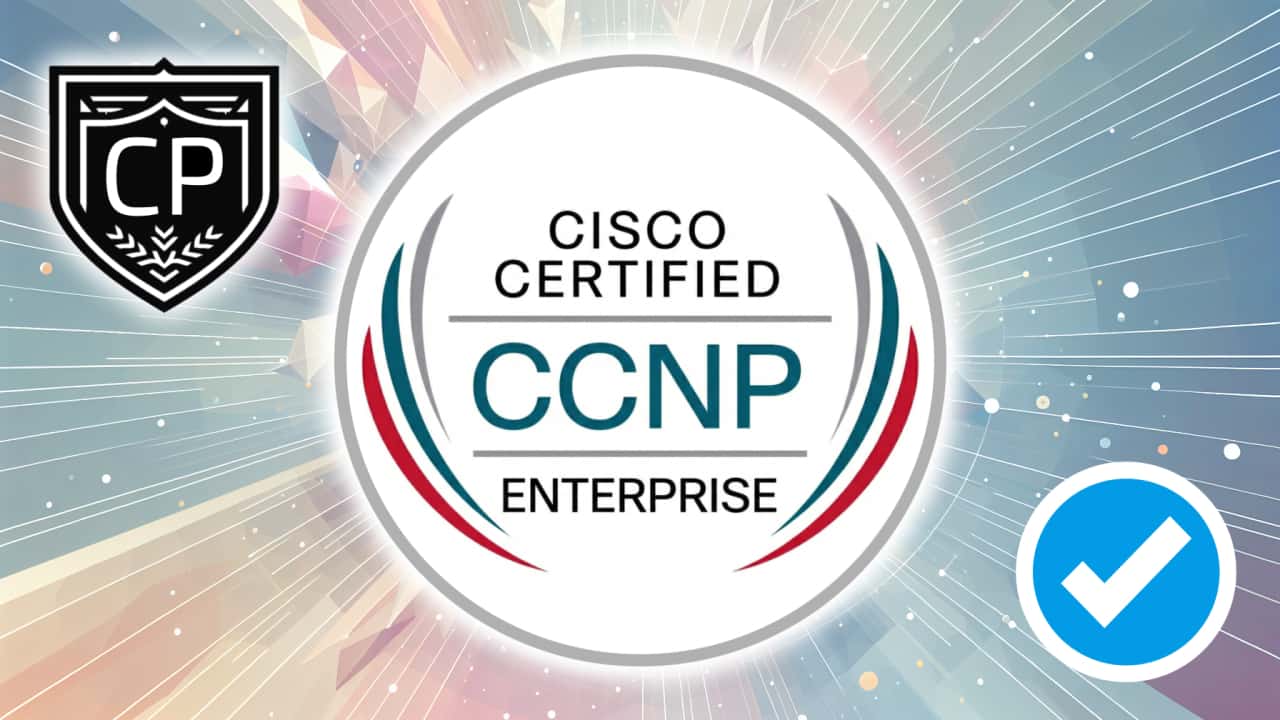
Prepare for the Cisco CCNP Enterprise ENARSI 300-410 exam with this concise overview covering domains, exam format, costs, study resources, and hands‑on skills for advanced enterprise routing, security, automation, and assurance.
Cisco Certified Network Professional CCNP Enterprise ENARSI 300-410 Quick Facts
Advance your Cisco networking expertise and open the door to enterprise network mastery with the CCNP Enterprise ENARSI 300-410 certification. This overview brings clarity and confidence to your preparation journey, giving you an insightful roadmap to strengthen your professional growth and technical excellence.
How does the CCNP ENARSI 300-410 certification elevate your enterprise networking skills?
The Cisco Certified Network Professional (CCNP) Enterprise ENARSI 300-410 certification validates advanced enterprise networking skills in routing, switching, security, infrastructure services, and automation. Designed for professionals who already possess foundational networking knowledge, ENARSI deepens your capabilities in implementing complex network solutions across enterprise environments. By earning this certification, candidates demonstrate proficiency in Cisco technologies that enable scalable, secure, and programmable networks, preparing them to manage evolving enterprise infrastructures with confidence.
Exam Domains Covered (Click to expand breakdown)
Exam Domain Breakdown
Domain 1: Architecture (15% of the exam)
1.1 Explain the different design principles used in an enterprise network
1.1.a High-level enterprise network design such as 2-tier, 3-tier, fabric, and cloud
1.1.b High availability techniques such as redundancy, FHRP, and SSO
1.1 summary: This section focuses on understanding network design fundamentals that support scalability, resilience, and operational simplicity. You’ll explore hierarchical network models such as 2-tier and 3-tier designs, as well as modern approaches like fabric and cloud-integrated topologies. The emphasis is on how well-structured designs create predictable performance and simplify troubleshooting in enterprise environments.
The second layer of understanding in this domain includes recognizing how high availability techniques fortify enterprise networks. Redundancy mechanisms, hot standby protocols, and stateful switchover ensure seamless service continuity during maintenance or unexpected events. Mastering these techniques prepares you to design enterprise architecture that meets demanding uptime requirements.
1.2 Explain the working principles of the Cisco Catalyst SD-WAN solution
1.2.a SD-WAN control and data planes elements
1.2.b Benefits and limitations of Catalyst SD-WAN solution
1.2 summary: This section introduces the core operational elements of Cisco Catalyst SD-WAN architecture. You’ll understand how the control and data planes work together to optimize traffic flows, enforce policy-based routing, and deliver secure connectivity between branches and data centers. Key components such as vSmart, vBond, and vEdge are essential to grasp in terms of their control and data exchange operations.
Additionally, you’ll assess the real-world benefits of adopting SD-WAN, including cost optimization, improved application performance, and centralized management visibility. Recognizing limitations and deployment considerations reinforces your ability to design SD-WAN architectures that align with enterprise strategies while maintaining operational flexibility.
1.3 Explain the working principles of the Cisco SD-Access solution
1.3.a SD-Access control and data planes elements
1.3.b Traditional campus interoperating with SD-Access
1.3 summary: This section deepens your understanding of Cisco SD-Access and its intent-based networking design. You’ll learn about the separation of control and data planes, the fabric overlay components, and how policy automation enhances secure campus connectivity. Understanding this model enables consistent configuration and simplified operations compared to traditional approaches.
You’ll also explore integration scenarios between traditional networks and SD-Access, ensuring smooth coexistence during enterprise transitions. Insight into how legacy systems and SD-Access interoperate helps you design environments that gradually evolve while maintaining continuous operations and performance consistency.
1.4 Interpret QoS configurations
1.4 summary: Quality of Service (QoS) ensures traffic prioritization across network applications. This section emphasizes reading and understanding QoS configurations, helping you evaluate how policies shape bandwidth allocation for voice, video, and data services. It enables you to identify queuing, marking, and policing mechanisms applied across different network segments.
Mastery of QoS configuration interpretation not only supports smooth network performance but also ensures service-level requirements are consistently achieved. You will gain the analytical awareness needed to maintain application quality without unnecessary congestion or packet loss.
Domain 2: Virtualization (10% of the exam)
2.1 Describe device virtualization technologies
2.1.a Hypervisor type 1 and 2
2.1.b Virtual machine
2.1.c Virtual switching
2.1 summary: This section explores how virtualization extends hardware efficiency and resource flexibility. You’ll differentiate between Type 1 and Type 2 hypervisors, understand the structure of virtual machines, and see how virtual switches facilitate communication among them. This knowledge underscores how virtualization simplifies deployment and network isolation.
In applying these concepts, you’ll see how device virtualization plays a critical role in modern enterprise infrastructures. The ability to segment workloads securely while efficiently using compute resources creates networks that are both cost-effective and scalable.
2.2 Configure and verify data path virtualization technologies
2.2.a VRF
2.2.b GRE and IPsec tunneling
2.2 summary: This section explains the use of VRF, GRE, and IPsec to create logical segmentation and secure communication tunnels. Understanding configuration and verification steps allows you to establish isolated routing instances and encrypted tunnels that unify diverse network segments safely.
This skill is central to building flexible, multi-tenant environments for enterprise operations and service providers. You’ll gain confidence in implementing secure overlays that preserve traffic integrity while optimizing inter-site connectivity.
2.3 Describe network virtualization concepts
2.3.a LISP
2.3.b VXLAN
2.3 summary: In this section, you’ll focus on newer network virtualization technologies that extend scalability. LISP simplifies endpoint mobility through mapping identifiers, while VXLAN expands Layer 2 reachability across IP-based fabric networks. Both help unify virtual and physical networks under a consistent policy framework.
By understanding these technologies, you become adept at designing networks that accommodate dynamic workloads and cloud-scale data centers. Their abstraction capabilities ensure flexibility and agility in the next-generation enterprise fabric.
Domain 3: Infrastructure (30% of the exam)
3.1 Layer 2
3.1.a Troubleshoot static and dynamic 802.1q trunking protocols
3.1.b Troubleshoot static and dynamic EtherChannels
3.1.c Configure and verify common Spanning Tree Protocols (RSTP, MST) and Spanning Tree enhancements such as root guard and BPDU guard
3.1 summary: This section builds your confidence in maintaining robust Layer 2 infrastructure. You will refine skills in diagnosing and resolving issues involving trunking and EtherChannel configurations, ensuring redundancy and load distribution. Understanding these mechanisms safeguards network reliability through proper link aggregation and VLAN segmentation.
In parallel, you’ll dive into Spanning Tree Protocol operations for loop prevention. Recognizing and configuring optimizations such as root guard and BPDU guard ensures stable and secure L2 topologies even as environments scale and evolve.
3.2 Layer 3
3.2.a Compare routing concepts of EIGRP and OSPF (advanced distance vector vs. link state, load balancing, path selection, path operations, metrics, and area types)
3.2.b Configure simple OSPFv2/v3 environments, including multiple normal areas, summarization, and filtering (neighbor adjacency, point-to-point, and broadcast network types, and passive-interface)
3.2.c Configure and verify eBGP between directly connected neighbors (best path selection algorithm and neighbor relationships)
3.2.d Describe policy-based routing
3.2 summary: This domain tests your understanding of key dynamic routing protocols and their foundational operations. You’ll differentiate characteristics of EIGRP and OSPF, including how they make path decisions and balance loads. Applying summarization and filtering techniques ensures optimized route advertisements in multi-area networks.
Further, you’ll learn to configure eBGP for inter-domain connectivity while integrating policy-based routing for granular traffic control. Understanding these capabilities enhances your ability to create highly adaptable and optimized routing environments for enterprise networks.
3.3 IP Services
3.3.a Interpret network time protocol configurations such as NTP and PTP
3.3.b Configure NAT/PAT
3.3.c Configure first hop redundancy protocols, such as HSRP, VRRP
3.3.d Describe multicast protocols, such as RPF check, PIM SM, IGMP v2/v3, SSM, bidir, and MSDP
3.3 summary: IP Services extend core connectivity reliability and synchronization in enterprise environments. You’ll learn how NTP and PTP maintain accurate timing across devices, while NAT and PAT configurations ensure secure and efficient address utilization across network boundaries.
You will also build confidence with redundancy and multicast configurations. This includes deploying HSRP and VRRP for resilient gateways and understanding multicast delivery mechanisms that optimize data distribution for real-time communication applications.
Domain 4: Network Assurance (10% of the exam)
4.1 Diagnose network problems using such as debugs, conditional debugs, traceroute, ping, SNMP, and syslog
4.1 summary: This section develops your capacity to systematically verify network health. By leveraging diagnostic tools like debugs, ping, and traceroute, you can isolate connectivity issues and validate operational performance. SNMP and syslog reinforce proactive monitoring for early detection.
Through structured troubleshooting, you gain practical insight into cause-and-effect patterns of network deviations. This fosters an analytical mindset necessary for real-time problem resolution and long-term stability of enterprise networks.
4.2 Configure and verify Flexible NetFlow
4.2 summary: In this section, you’ll focus on visibility and performance analysis using Cisco Flexible NetFlow. Configuration and verification allow you to track flow data, monitor traffic trends, and identify network anomalies effectively.
NetFlow insights become essential for capacity planning and security anomaly detection. Mastering its configuration empowers you to keep enterprise traffic optimized and compliant with operational policies.
4.3 Configure SPAN/RSPAN/ERSPAN
4.3 summary: This section highlights how to mirror and analyze packets for performance and security validation. You’ll learn when to use SPAN, RSPAN, or ERSPAN depending on the visibility needs across network segments.
By using these monitoring techniques, you enhance troubleshooting efficiency and gain precise insights into live network behavior without service interruption.
4.4 Configure and verify IPSLA
4.4 summary: You’ll gain expertise in proactive network monitoring using IP SLA. Configuring IP SLA enables synthetic traffic testing to measure latency, jitter, and availability in live networks.
This technique becomes a cornerstone for benchmarking performance and validating service-level agreements. It supports predictive maintenance before users experience disruptions.
4.5 Describe how Cisco Catalyst Center (formerly Cisco DNA Center) is used to apply network configuration, monitoring, and management using traditional and AI-powered workflows
4.5 summary: This section introduces Cisco Catalyst Center’s role in simplifying enterprise network operations. You’ll see how automated configuration deployment and AI-driven insights streamline performance management and policy enforcement.
Embracing these tools unites automation with visibility, enabling consistent, scalable infrastructure oversight that reduces manual work while improving precision.
4.6 Configure and verify NETCONF and RESTCONF
4.6 summary: This section strengthens your ability to operate networks programmatically. You’ll configure and validate device state and configuration using secure YANG-based protocols such as NETCONF and RESTCONF.
By understanding these APIs, you prepare for modern network automation strategies that improve collaboration between operations and development teams.
Domain 5: Security (20% of the exam)
5.1 Configure and verify device access control
5.1.a Lines and local user authentication
5.1.b Authentication and authorization using AAA
5.1 summary: You’ll develop the ability to secure administrative access using varied authentication mechanisms. Configuration of local and AAA-based controls ensures accountability and reliable credential enforcement.
Understanding access control at both local and centralized levels promotes safe administration across enterprise networks. It supports compliance and role-based privileges that align with operation policies.
5.2 Configure and verify infrastructure security features
5.2.a ACLs
5.2.b CoPP
5.2 summary: This section delves into protecting network infrastructure using access control lists and control plane policing. Configuring these mechanisms allows traffic filtering and CPU protection from excessive or unauthorized packets.
By combining ACL and CoPP strategies, you can safeguard both management and data planes, thereby fortifying overall platform integrity in multi-tenant environments.
5.3 Describe REST API security
5.3 summary: REST API security reinforces trust in automated communication between network systems. You’ll learn methods to authenticate requests, enforce TLS encryption, and implement token-based access to safeguard programmatic operations.
Understanding these elements ensures every integration adheres to secure-by-design principles. It promotes a uniform security posture across interfaces used by network management tools.
5.4 Describe the components of network security design
5.4.a Threat defense
5.4.b Endpoint security
5.4.c Next-generation firewall
5.4.d TrustSec and MACsec
5.4 summary: This section examines Cisco’s layered approach to network security. It encompasses solutions like next-generation firewalls, endpoint protection, and segmentation using TrustSec and MACsec to ensure data confidentiality.
You’ll gain strategic insight into how these components collaborate to form comprehensive defense-in-depth architecture. Integrating threat intelligence and encryption techniques ensures enterprise networks remain resilient from edge to core.
Domain 6: Automation and Artificial Intelligence (15% of the exam)
6.1 Interpret basic Python components and scripts
6.1 summary: You’ll examine Python’s core structures to automate repetitive network tasks. Through interpretation of scripts, you build insight into data parsing, conditional logic, and integration with Cisco management APIs.
This skill supports continual learning in automation, equipping you to streamline operations, reduce manual errors, and enhance accuracy in configuration management.
6.2 Construct valid JSON-encoded files
6.2 summary: This section enhances your understanding of how structured data is represented for APIs and automation tools. You’ll learn to format and validate JSON documents that interact with Cisco systems seamlessly.
By building confidence in data standardization, you enable smooth communication between network devices and orchestration platforms that rely on structured payloads.
6.3 Describe the high-level principles and benefits of a data modeling language, such as YANG
6.3 summary: Here, you’ll explore YANG as a data modeling standard for network configuration management. Understanding its structure allows consistent communication between devices and controllers.
Appreciating YANG’s modularity also illustrates how standardized interfaces promote interoperability and automation consistency across diverse network devices.
6.4 Describe APIs for Cisco Catalyst Center and SD-WAN Manager
6.4 summary: In this section, you will uncover opportunities that Cisco APIs offer for programmability. You’ll understand how APIs are structured and how teams use them to automate Catalyst Center and SD-WAN Manager tasks.
With this insight, you can design integrated workflows that deliver rapid, reliable configuration and reporting automation across management systems.
6.5 Interpret REST API response codes and results in payload using Cisco Catalyst Center and RESTCONF
6.5 summary: This topic helps you read and interpret REST API responses. You’ll learn how different HTTP codes indicate request success or adjustment needs, and how to parse payloads for actionable metrics.
Developing this fluency allows you to verify automation outcomes effectively, ensuring your network scripts communicate accurately with Cisco platforms.
6.6 Construct an EEM applet to automate configuration, troubleshooting, or data collection
6.6 summary: This section emphasizes local automation within Cisco devices. You’ll learn to create Embedded Event Manager (EEM) applets that respond automatically to events or thresholds in real time.
EEM knowledge enables proactive automation that enhances operational responsiveness and supports preventive maintenance through automated responses.
6.7 Compare agent vs. agentless orchestration tools
6.7 summary: This section reviews orchestration model differences and their operational benefits. You’ll distinguish tools that install agents on managed devices from those that interact remotely through APIs.
Understanding these approaches equips you to select the right automation model for your enterprise, ensuring simplicity, scalability, and seamless management integration.
Who Should Pursue the Cisco Certified Network Professional CCNP Enterprise ENARSI 300-410 Certification?
The CCNP Enterprise ENARSI 300-410 certification is designed for networking professionals who are ready to demonstrate advanced knowledge in enterprise network implementation, troubleshooting, and security. It’s ideal for:
Experienced network engineers aiming to validate specialized routing and infrastructure expertise
IT professionals looking to progress toward CCIE-level certifications
Systems and support engineers managing multi-layer enterprise networks
Aspiring network architects seeking deeper understanding of Cisco enterprise technologies
If you’re ready to advance beyond associate-level skills, the ENARSI certification empowers you to stand out as a technical expert in enterprise connectivity and optimization.
What Skills Does the CCNP Enterprise ENARSI 300-410 Certification Validate?
This certification focuses on developing practical, hands-on skills to design, implement, and troubleshoot complex enterprise networks. You’ll demonstrate your ability to:
Configure and verify enterprise routing technologies such as OSPF, EIGRP, and BGP
Support VPN and tunneling protocols for secure data transport
Implement network automation, assurance, and security mechanisms
Optimize the performance and resilience of dual-stack (IPv4 and IPv6) networks
By mastering these areas, you’ll be ready to deliver stable, efficient, and scalable network solutions to leading global organizations.
How Many Exams Are Required to Earn the CCNP Enterprise Credential?
To achieve the CCNP Enterprise certification, you must pass:
A core exam – 350-401 ENCOR (Implementing and Operating Cisco Enterprise Network Core Technologies)
A concentration exam – such as 300-410 ENARSI (Implementing Cisco Enterprise Advanced Routing and Services)
Passing both establishes you as a certified CCNP Enterprise professional, while each individual exam also provides a Cisco Specialist certification in its area of focus.
How Much Does the ENARSI 300-410 Exam Cost?
The Cisco ENARSI 300-410 exam costs $400 USD, or you may choose to redeem Cisco Learning Credits. Keep in mind that prices vary slightly by region, and taxes may apply. Considering the global reputation of Cisco credentials, this investment opens the door to some of the most lucrative network engineering roles in the industry.
How Long Is the ENARSI 300-410 Exam?
You’ll have 120 minutes to complete the ENARSI 300-410 exam. The timed nature encourages efficient thinking and real-world problem-solving. Proper pacing is important—answer the questions you know first, then revisit those requiring deeper analysis.
How Many Questions Are on the CCNP ENARSI 300-410 Exam?
The exam includes approximately 110 questions, featuring a mix of multiple-choice, multi-select, and case-based questions. Each question type reflects real-world scenarios that require applied problem-solving skills. Understanding command outputs, troubleshooting flows, and topology analysis will help you excel.
What Is the Passing Score for the ENARSI 300-410 Exam?
The passing score is 83%. Cisco uses a scaled scoring model to ensure fairness and consistency across exam versions. Focus on mastering each domain—especially routing and security—to maintain a well-balanced knowledge base that leads to success.
In What Languages Is the Cisco 300-410 ENARSI Exam Available?
The ENARSI 300-410 exam is currently offered in English and Japanese. This ensures accessibility to a global audience of Cisco professionals. You can schedule your preferred exam language through Pearson VUE’s online system when booking your test.
What Topics Are Covered on the ENARSI 300-410 Exam?
The 300-410 ENARSI exam covers the following six domains, each weighted according to Cisco’s official blueprint:
Architecture (15%) – High-level enterprise design, redundancy, and SD-WAN/SD-Access operation
Virtualization (10%) – Device and network virtualization using VRF, GRE, and IPsec tunneling
Infrastructure (30%) – In-depth coverage of switching, routing, and IP services protocols
Network Assurance (10%) – Monitoring, diagnostics, and configuration validation tools
Automation and AI (15%) – Using Python, YANG, NETCONF/RESTCONF, and orchestration tools
Together, these domains ensure you have end-to-end knowledge of modern enterprise network environments.
Are There Any Prerequisites for Taking the 300-410 ENARSI Exam?
There are no formal prerequisites, but Cisco recommends candidates have 3 to 5 years of experience implementing enterprise network solutions. Prior CCNA-level knowledge is strongly advised, as it serves as a foundation for understanding routing, switching, and network design fundamentals.
What Types of Questions Should I Expect on the Exam?
The ENARSI exam includes scenario-based questions, configuration snippets, and diagnostic questions that measure your ability to troubleshoot real network issues. Expect practical situations where you’ll apply routing, VPN, and security configurations—ensuring you can think critically in enterprise environments.
What Jobs Can You Get After Earning the CCNP Enterprise ENARSI Certification?
With CCNP Enterprise credentials, you qualify for advanced networking positions, including:
Network Engineer
Infrastructure Engineer
Network Operations Specialist
Systems or Solutions Engineer
Network Automation Engineer
These roles exist across industries such as telecommunications, finance, healthcare, and cloud infrastructure, showcasing your capability to manage enterprise-scale networks.
How Long Is the Cisco CCNP Enterprise Certification Valid?
Your CCNP Enterprise certification is valid for three years. You can maintain active status by passing any professional-level exam, a higher-level Cisco certification (like CCIE), or completing continuing education credits through Cisco’s recertification program.
What Training or Study Paths Does Cisco Recommend?
Cisco provides comprehensive learning options for ENARSI exam preparation, including:
Instructor-led training – Official Implementing Cisco Enterprise Advanced Routing and Services (ENARSI) course
Self-paced e-learning – Cisco Digital Learning Library
Hands-on labs – Practice through Cisco Packet Tracer, GNS3, or real lab gear
Community resources – Cisco’s discussion boards and peer study groups
Combining theoretical learning with practical lab experience ensures you retain the skills needed for success.
What Knowledge Areas Should Candidates Focus On?
For best results, emphasize these technical areas:
Routing Protocols – OSPF, EIGRP, and BGP configuration and troubleshooting
VPN Technologies – MPLS, DMVPN, and IPsec operation
Network Security Fundamentals – AAA, ACLs, TrustSec, and MACsec
Network Assurance Mechanisms – Flexible NetFlow, IP SLA, and SNMP monitoring
Proficiency across these fields makes you exceptionally well-prepared for real-world enterprise networking environments.
How Can I Prepare Effectively for the CCNP ENARSI Exam?
Preparation for the ENARSI exam benefits greatly from combining theory, labs, and practice. Use multiple study resources, including Cisco’s official course, lab simulators, and realistic ENARSI 300-410 practice exams with full explanations that mirror the Cisco testing environment. These resources reinforce understanding and boost confidence before exam day.
What Are Common Pitfalls Candidates Should Avoid?
Many test-takers advance faster by avoiding common missteps:
Overlooking hands-on configuration practice—command familiarity is essential
Neglecting network automation topics, which are increasingly emphasized
Studying only legacy routing concepts without newer architecture models like SD-WAN or SD-Access
Balanced preparation across every blueprint domain ensures a comprehensive understanding that extends beyond the exam itself.
How Do I Register for the Cisco ENARSI 300-410 Exam?
To register, visit Cisco’s Pearson VUE exam portal, log in with your Cisco ID, select Implementing Cisco Enterprise Advanced Routing and Services (ENARSI 300-410), and choose your preferred testing method (online or in-person). You’ll then select your exam date, complete payment, and receive scheduling confirmation.
What Is the Difference Between the ENCOR and ENARSI Exams?
ENCOR (350-401) is the core exam validating foundational enterprise network knowledge across architectures, while ENARSI (300-410) is a concentration exam specializing in advanced routing and troubleshooting. Together, they complete the pathway to earning the full CCNP Enterprise credential, cementing your multifaceted expertise.
Is the CCNP ENARSI 300-410 Certification Worth It?
Absolutely. The ENARSI certification not only validates your command of enterprise routing solutions but also signals to employers that you are ready to take on complex network automation and optimization roles. With Cisco technologies used across industries worldwide, this credential represents a career-transforming investment.
Where Can I Learn More About the Official Cisco CCNP Enterprise Certification?
For detailed exam topics, training resources, and Cisco’s certification roadmap, visit the official Cisco CCNP Enterprise certification page. There you’ll find updates, learning materials, and links to schedule your exams directly with Cisco and Pearson VUE.
The Cisco Certified Network Professional (CCNP) Enterprise ENARSI 300-410 certification is your passport to mastering complex network infrastructures and advancing within the global IT landscape. With the right preparation, hands-on skills, and professional mindset, you’ll be well on your way to becoming a leader in enterprise network engineering.