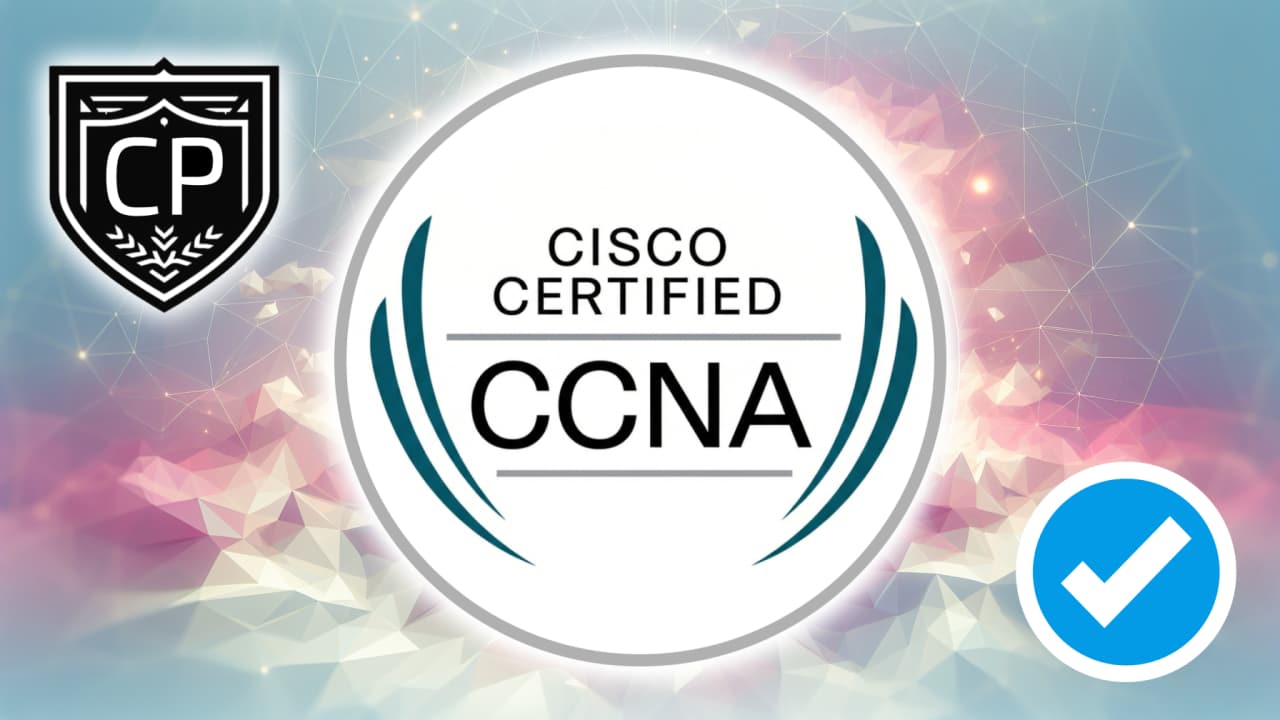
Cisco Certified Network Associate CCNA Quick Facts (2025)

Comprehensive Cisco Certified Network Associate (CCNA) 200-301 exam overview — covering exam objectives, domain weightings, format, duration, cost, passing score, study tips, and career paths to help you prepare and pass.

Cisco Certified Network Associate CCNA Quick Facts
5 min read
Cisco CCNACCNA 200-301200-301 CCNACCNA examCCNA exam overview
Table of Contents

Cisco Certified Network Associate CCNA Quick Facts

The Cisco Certified Network Associate (CCNA) certification empowers you to build, manage, and optimize modern enterprise networks with confidence. This overview provides all the essential details you need to successfully prepare for the 200-301 CCNA exam and understand exactly what skills it validates.

What makes the Cisco Certified Network Associate (CCNA) certification valuable?

The CCNA certification verifies a professional’s ability to install, configure, operate, and troubleshoot small to medium-sized enterprise networks. It is recognized worldwide as the foundational Cisco networking credential, demonstrating proficiency across core networking topics such as IP connectivity, security, automation, and wireless fundamentals. Earning the CCNA signals that you have both the theoretical knowledge and hands-on expertise to manage today’s evolving network environments, whether on-premises, hybrid, or cloud-driven.

Exam Domains Covered (Click to expand breakdown)

Exam Domain Breakdown

Domain 1: Network Fundamentals (20% of the exam)

Explain the role and function of network components

  • Routers
  • Layer 2 and Layer 3 switches
  • Next-generation firewalls and IPS
  • Access points
  • Controllers
  • Endpoints
  • Servers
  • PoE

Section summary: This topic focuses on recognizing how each network component contributes to an enterprise environment. You will learn the core purposes of routers for forwarding traffic, switches for local segmentation, and firewalls for enforcing security policies. Understanding components like controllers, access points, and endpoints helps you visualize how wired and wireless devices work together to form a cohesive network architecture.

In addition, you will explore how network devices such as servers and PoE switches provide scalability and efficiency by supporting services and power delivery simultaneously. These fundamentals form the foundation upon which more complex concepts like WAN design and automation are built, preparing you to identify the correct device type and its role in any given topology.

Describe characteristics of network topology architectures

  • Two-tier
  • Three-tier
  • Spine-leaf
  • WAN
  • Small office/home office (SOHO)
  • On-premises and cloud

Section summary: This topic teaches the structure of network topology architectures and why they are designed in specific ways. You will explore how layered and flattened designs like two-tier and spine-leaf architectures enhance scalability and redundancy in enterprise networks.

Through practical examples ranging from traditional on-premises topologies to cloud-connected systems, you will develop insight into when to apply each model. Recognizing how SOHO environments differ from larger networks equips you to balance simplicity and performance while aligning with business needs.

Compare physical interface and cabling types

  • Single-mode fiber, multimode fiber, copper
  • Connections (Ethernet shared media and point-to-point)

Section summary: This section covers the physical aspects of network connectivity. You will understand the characteristics and ideal use cases for various cable materials, including fiber and copper media types, and how physical connections influence network performance.

Learning to differentiate between Ethernet shared media and point-to-point links prepares you to select the appropriate cable type for distance, speed, and reliability requirements. This knowledge ensures accurate setup and troubleshooting at the hardware level.

Identify interface and cable issues (collisions, errors, mismatch duplex, and/or speed)

Section summary: Here you will recognize and resolve physical and data link layer interface issues. The focus is on identifying indicators of collisions, speed mismatches, and duplex inconsistencies that degrade performance.

Mastering these diagnosis methods ensures you can maintain optimal throughput and link integrity. You will also strengthen your ability to interpret interface statistics and apply best practices for clean network operation.

Compare TCP to UDP

Section summary: In this section, you will examine the fundamental differences between the TCP and UDP protocols. You will learn about their reliability mechanisms, connection orientation, and appropriate application scenarios.

Understanding how TCP ensures ordered delivery and how UDP offers faster message transmission without session overhead helps you choose the ideal protocol for each application’s performance requirements.

Configure and verify IPv4 addressing and subnetting

Section summary: This section focuses on calculating and assigning IPv4 addresses within networks. By practicing subnetting and verifying configurations, you'll ensure IP schemes are accurately designed for efficient address use.

Developing proficiency in subnet masks, prefixes, and ranges enhances your ability to plan connectivity across multiple subnets while preventing overlaps and addressing errors.

Describe private IPv4 addressing

Section summary: This section highlights the difference between public and private IPv4 addressing. You will understand how private ranges enable secure communication within internal networks without direct internet exposure.

Recognizing address scopes and their proper implementation ensures compliance with NAT strategies and supports scalable internal addressing configurations.

Configure and verify IPv6 addressing and prefix

Section summary: IPv6 concepts are covered here to keep you current with modern addressing standards. You’ll learn the structure of IPv6 addresses, how to assign them, and how to verify proper configuration.

By practicing with extended prefixes and hierarchical address assignments, you build understanding of IPv6’s scalability and efficient routing design.

Describe IPv6 address types

  • Unicast (global, unique local, and link local)
  • Anycast
  • Multicast
  • Modified EUI 64

Section summary: You will identify the main categories of IPv6 addressing and their specific roles in network communication. Unicast supports one-to-one communication, while multicast and anycast address groups of receivers for optimized delivery.

Learning to recognize and apply these address types enables more efficient traffic management and an understanding of modern network routing capabilities.

Verify IP parameters for Client OS (Windows, Mac OS, Linux)

Section summary: This section focuses on verifying end-device configurations. You will practice checking network parameters like IP address, gateway, and DNS assignments across different operating systems.

Such verification skills ensure smooth connectivity for users and prepare you to troubleshoot service issues at the device level in mixed environments.

Describe wireless principles

  • Nonoverlapping Wi-Fi channels
  • SSID
  • RF
  • Encryption

Section summary: Here, you will explore the basic wireless networking principles that maintain reliable performance. You will understand how SSIDs identify networks, how channel selection prevents interference, and how encryption protects data transmission.

Grasping both RF fundamentals and wireless security ensures that you can configure Wi-Fi to achieve optimal throughput and secure access across devices.

Explain virtualization fundamentals (server virtualization, containers, and VRFs)

Section summary: Virtualization is key to scalable network management. This section introduces how virtualized devices and segmentation technologies integrate into network operations.

You’ll see how concepts like VRFs, containers, and virtual machines create isolated environments that simplify deployment and improve hardware utilization.

Describe switching concepts

  • MAC learning and aging
  • Frame switching
  • Frame flooding
  • MAC address table

Section summary: This section dives into Layer 2 switching processes. You’ll learn how switches build and maintain MAC address tables and how they forward and flood frames to establish connectivity within broadcast domains.

Understanding these mechanisms allows you to diagnose performance or saturation issues and configure switches to forward traffic efficiently.

Domain 2: Network Access (20% of the exam)

Configure and verify VLANs (normal range) spanning multiple switches

  • Access ports (data and voice)
  • Default VLAN
  • InterVLAN connectivity

Section summary: This section builds understanding of VLAN segmentation to separate traffic for security and efficiency. You will configure and verify VLANs on multiple switches and explore access ports for data and voice.

By learning to manage default VLANs and enable InterVLAN communication, you’ll improve traffic management between network segments and ensure reliable operations across environments.

Configure and verify interswitch connectivity

  • Trunk ports
  • 802.1Q
  • Native VLAN

Section summary: Focus here is on interswitch communication and VLAN tagging with 802.1Q. You’ll configure trunk ports to carry multiple VLANs across switches while ensuring correct native VLAN assignments.

These skills help maintain proper traffic segmentation and facilitate the connection of network segments across larger infrastructures.

Configure and verify Layer 2 discovery protocols (Cisco Discovery Protocol and LLDP)

Section summary: This section introduces device discovery and how it simplifies network management. You’ll configure CDP and LLDP to identify neighbors and confirm device connectivity.

Understanding these protocols supports clear network documentation, device verification, and troubleshooting communication paths.

Configure and verify (Layer 2/Layer 3) EtherChannel (LACP)

Section summary: EtherChannel configuration enhances bandwidth and redundancy between switches and routers. You’ll configure LACP for both Layer 2 and Layer 3 connectivity.

This aggregated link technology provides high availability and load balancing, essential for enterprise-level performance.

Interpret basic operations of Rapid PVST+ Spanning Tree Protocol

  • Root port, root bridge (primary/secondary), and other port names
  • Port states and roles
  • PortFast
  • Root guard, loop guard, BPDU filter, and BPDU guard

Section summary: This section teaches loop prevention and path optimization using Rapid PVST+. You’ll identify the root bridge and associated port roles, as well as implement guard functions and PortFast.

Understanding Spanning Tree operation ensures fault-tolerant switch networks that automatically adapt to topology changes.

Describe Cisco Wireless Architectures and AP modes

Section summary: You will gain an understanding of wireless deployment models and how Cisco AP modes manage traffic. This includes centralized, distributed, and cloud-managed operations.

Recognizing these architectures helps you plan efficient WLAN implementations and integrate wireless controllers effectively.

Describe physical infrastructure connections of WLAN components (AP, WLC, access/trunk ports, and LAG)

Section summary: This section covers how APs, controllers, and switches connect physically and logically. You will identify the required port types and aggregation principles.

Mastering these physical design basics ensures seamless wireless coverage and controller communication for optimized performance.

Describe network device management access (Telnet, SSH, HTTP, HTTPS, console, TACACS+/RADIUS, and cloud managed)

Section summary: Management access topics cover secure and efficient device administration methods. You’ll learn the distinctions between protocols and authentication mechanisms.

With this knowledge, you’ll be able to maintain network devices safely, apply centralized authentication, and support hybrid management models.

Interpret the wireless LAN GUI configuration for client connectivity, such as WLAN creation, security settings, QoS profiles, and advanced settings

Section summary: This section explores the Wi-Fi GUI interface to build and analyze wireless networks. You’ll practice configuring WLANs, applying security parameters, and defining service quality priorities.

Through hands-on awareness of GUI-driven designs, you’ll align network policies to user experience requirements.

Domain 3: IP Connectivity (25% of the exam)

Interpret the components of routing table

  • Routing protocol code
  • Prefix
  • Network mask
  • Next hop
  • Administrative distance
  • Metric
  • Gateway of last resort

Section summary: This section introduces routing concepts fundamental to IP communication. You’ll interpret how routers use metrics, administrative distance, and next hops to choose optimal paths.

Mastering the routing table layout builds your ability to diagnose connectivity and tune routing performance in enterprise deployments.

Determine how a router makes a forwarding decision by default

  • Longest prefix match
  • Administrative distance
  • Routing protocol metric

Section summary: You’ll study routing algorithm behavior and the logic behind packet forwarding decisions. This includes learning how longest prefix match ensures precision routing.

By understanding these priority mechanisms, you’ll predict routing outcomes and fine-tune network performance.

Configure and verify IPv4 and IPv6 static routing

  • Default route
  • Network route
  • Host route
  • Floating static

Section summary: This section focuses on building manual routing paths. You will configure different static route types, verify connectivity, and apply floating routes for fallback scenarios.

Developing accuracy in route configuration enhances reliability and provides the foundational routing skills needed for automation and dynamic protocols.

Configure and verify single area OSPFv2

  • Neighbor adjacencies
  • Point-to-point
  • Broadcast (DR/BDR selection)
  • Router ID

Section summary: You’ll configure OSPFv2 to enable dynamic routing within a single area. Topics include establishing adjacencies and understanding DR/BDR roles.

Hands-on configuration practice builds proficiency with scalable link-state routing, ensuring adaptability in large topologies.

Describe the purpose, functions, and concepts of first hop redundancy protocols

Section summary: This section demonstrates how FHRPs like HSRP provide continuous gateway availability. You’ll learn operational concepts and prioritization within redundancy groups.

These technologies ensure seamless traffic forwarding even during device failure, supporting network uptime and service continuity.

Domain 4: IP Services (10% of the exam)

Configure and verify inside source NAT using static and pools

Section summary: NAT is a vital translation service for enterprise internet connectivity. You’ll configure static NAT and dynamic pools to conserve addresses and enable outbound communication.

Comprehending NAT behavior helps secure internal addressing and ensure consistent connectivity across dynamic infrastructure.

Configure and verify NTP operating in a client and server mode

Section summary: This section teaches network time synchronization between devices using NTP. You’ll configure equipment as both clients and servers.

Ensuring accurate time alignment supports logging, security policies, and consistent event tracking across distributed systems.

Explain the role of DHCP and DNS within the network

Section summary: DHCP and DNS form the backbone of basic IP communication. You’ll study how DHCP dynamically assigns addresses and how DNS resolves hostnames to IPs.

Understanding and verifying their cooperation ensures seamless client onboarding and reliable service resolution.

Explain the function of SNMP in network operations

Section summary: This section introduces SNMP as the protocol that enables monitoring and management visibility. You’ll evaluate SNMP versions and community configurations.

Using SNMP effectively ensures proactive diagnosis, efficient resource management, and data-driven maintenance.

Describe the use of syslog features, including facilities and severity levels

Section summary: Here, you’ll understand how system logging captures valuable operational details. Key topics include severity interpretation and log filtering.

Establishing a well-structured syslog environment supports ongoing performance assessment and compliance reporting.

Configure and verify DHCP client and relay

Section summary: This section expands DHCP concepts by demonstrating client requests and relay agent forwarding. You’ll configure both ends to ensure smooth address distribution across subnets.

These configurations facilitate large-scale network expansion while maintaining consistent addressing logic.

Explain the forwarding per-hop behavior (PHB) for QoS such as classification, marking, queuing, congestion, policing, and shaping

Section summary: This topic covers the fundamentals of quality of service configuration. You’ll classify and mark traffic and understand how mechanisms like queuing and shaping support performance.

Implementing QoS policies helps sustain priority applications and provide reliable delivery under varying load conditions.

Configure network devices for remote access using SSH

Section summary: SSH ensures secure administrative communication. You’ll configure remote access parameters and verify data encryption.

Securing management access through SSH enhances privacy and control, supporting robust operational governance.

Describe the capabilities and functions of TFTP/FTP in the network

Section summary: You’ll explore TFTP and FTP as legacy and modern transfer protocols for device images and configurations. Each has unique reliability and security characteristics.

Learning these utilities helps you perform file handling tasks securely during device setup and backup operations.

Domain 5: Security Fundamentals (15% of the exam)

Define key security concepts (threats, vulnerabilities, exploits, and mitigation techniques)

Section summary: This section builds awareness of common security principles and defensive strategies. You’ll recognize how vulnerabilities become exploitable and how proper configuration mitigates risks.

Developing this foundation equips you to design and maintain secure, resilient architectures aligned with enterprise policies.

Describe security program elements (user awareness, training, and physical access control)

Section summary: You will examine the organizational aspects of security. Implementing human and physical controls forms a complete protective strategy.

Emphasizing awareness and education ensures proactive participation in safeguarding network assets.

Configure and verify device access control using local passwords

Section summary: You’ll learn to secure device entry through local accounts and password management. Properly configuring authentication means minimizing unauthorized access.

This knowledge reinforces operational discipline and compliance in managing Cisco devices securely.

Describe security password policy elements, such as management, complexity, and password alternatives (multifactor authentication, certificates, and biometrics)

Section summary: Policy-driven password strategies provide layered security. You’ll understand complexity requirements and the roles of modern alternatives such as multifactor authentication.

Applying these principles creates stronger authentication environments that enhance resilience against unauthorized logins.

Describe IPsec remote access and site-to-site VPNs

Section summary: This section explains how VPN technologies secure data crossing networks. You’ll distinguish between remote access and site-to-site models.

Understanding encryption, tunnels, and authentication processes equips you to establish secure communications for distributed offices.

Configure and verify access control lists

Section summary: You’ll master ACL construction to control packet flow and segment access. Practical examples will illustrate filtering based on IP, protocol, and port criteria.

Applying ACLs strategically enforces security policies efficiently without disrupting legitimate traffic paths.

Configure and verify Layer 2 security features (DHCP snooping, dynamic ARP inspection, and port security)

Section summary: Layer 2 security measures protect against local attacks. You’ll configure DHCP snooping to validate sources and ARP inspection to block spoofing.

Port security mechanisms strengthen endpoint control and prevent unauthorized device connections on access ports.

Compare authentication, authorization, and accounting concepts

Section summary: This section gives conceptual clarity on AAA frameworks. You’ll learn how each function contributes to identity control and usage auditing.

AAA principles are instrumental in creating a scalable security model for both local and cloud-based systems.

Describe wireless security protocols (WPA, WPA2, and WPA3)

Section summary: Wireless encryption standards are essential for data protection. You’ll compare WPA versions and encryption mechanisms.

Knowing protocol evolution ensures you can configure the highest available protection for user traffic.

Configure and verify WLAN within the GUI using WPA2 PSK

Section summary: This section blends theory with interface practice. You’ll apply WPA2 PSK settings through graphical management tools to secure wireless access.

Performing these configurations reinforces your understanding of authentication mechanics in managed Wi-Fi environments.

Domain 6: Automation and Programmability (10% of the exam)

Explain how automation impacts network management

Section summary: This section introduces automation as a modern enhancement to administrative workflows. You’ll explore how scripts and APIs reduce manual tasks and increase reliability.

Adopting automation improves scalability, minimizes errors, and frees engineers to focus on strategic improvements.

Compare traditional networks with controller-based networking

Section summary: By comparing legacy network models to centralized architectures, you’ll see how controllers optimize configuration and monitoring.

This understanding enables smooth transitions to software-defined networks that provide greater visibility and adaptability.

Describe controller-based, software defined architecture (overlay, underlay, and fabric)

  • Separation of control plane and data plane
  • Northbound and Southbound APIs

Section summary: Here you’ll learn how software-defined networking operates through layered abstractions. Understanding control and data plane separation builds clarity on orchestration.

Study of APIs reveals how applications communicate with controllers to automate configuration at scale.

Explain AI (generative and predictive) and machine learning in network operations

Section summary: AI-driven analysis helps maintain consistent network health. This section highlights predictive and generative applications within network monitoring.

Recognizing these capabilities empowers you to apply data analytics for proactive optimization and rapid decision-making.

Describe characteristics of REST-based APIs (authentication types, CRUD, HTTP verbs, and data encoding)

Section summary: REST APIs form the backbone of modern automation. You’ll learn principles of CRUD operations and how authentication enables secure exchanges.

Understanding how APIs communicate using common web protocols equips you to integrate programmable configurations efficiently.

Recognize the capabilities of configuration management mechanisms such as Ansible and Terraform

Section summary: This section examines the role of configuration management tools. You’ll understand how they automate deployment and maintain consistency across large infrastructures.

Learning about their capabilities provides insight into CI/CD workflows and standardized operational practices.

Recognize components of JSON-encoded data

Section summary: You’ll identify how JSON data structures support API communication. Key details include key-value pair formatting and nesting.

Fluency in reading and writing JSON ensures accuracy in programming interactions, a central skill in network automation.

Who Should Pursue the Cisco Certified Network Associate (CCNA) Certification?

The Cisco Certified Network Associate (CCNA) certification is perfect for individuals who want to build a strong foundation in networking and elevate their IT careers. It’s designed for:

  • Aspiring network administrators, engineers, or support technicians
  • IT professionals looking to validate or expand their networking expertise
  • Students and early-career professionals launching into the IT field
  • Professionals from adjacent tech areas (security, software, systems) seeking networking skills

This certification demonstrates your ability to manage, secure, and troubleshoot modern networks—making you a valuable asset to any organization.

What Career Opportunities Can CCNA Help You Unlock?

Earning your CCNA shows employers that you have practical skills in configuring and troubleshooting networks. It opens doors to roles such as:

  • Network Administrator
  • Network Support Engineer
  • Systems Engineer
  • IT Specialist
  • Network Technician

As you gain experience, you can grow into advanced positions like Network Architect, Security Engineer, or Cloud Network Administrator. The CCNA is a solid launch pad for a lifelong tech career.

What Is the Current Version and Exam Code?

The current CCNA certification exam is 200-301: Implementing and Administering Cisco Solutions (v1.1). This version reflects modern networking, covering topics like automation, security, wireless architecture, and programmability. Always ensure your study materials align with this exam code for the most accurate preparation.

How Much Does the Cisco CCNA Exam Cost?

The Cisco 200-301 CCNA exam costs $300 USD. Cisco Learning Credits can also be used as payment if your employer provides them. Exam prices may vary slightly based on location and local currency conversion. This investment helps accelerate your career progression in one of today’s most in-demand IT skill areas.

How Long Is the CCNA Exam and How Many Questions Are Included?

The CCNA exam includes approximately 110 questions, giving you 120 minutes to complete everything. The questions come in multiple formats—multiple choice, drag-and-drop, and performance-based scenarios. Good pacing and exam strategy are essential, especially for simulation-style questions that test your ability to apply concepts to real network environments.

What is the Passing Score for the 200-301 CCNA Exam?

To earn the CCNA certification, you need a passing score of around 83%. Results are issued on a pass/fail basis and available online within 48 hours after completing your test. Cisco’s scoring model focuses on the overall score, so you aren’t required to pass individual sections—your total performance determines success.

What Languages Are Available for the CCNA Exam?

The exam is currently offered in English and Japanese. Cisco continually evaluates global demand and may expand language offerings in the future. Be sure to select your preferred language when scheduling your exam through Pearson VUE.

What Are the Main Exam Domains and Their Weightings?

The CCNA 200-301 exam blueprint includes six key domains. Each domain tests different technical areas vital to managing and securing modern networks:

  1. Network Fundamentals (20%) – Core networking components, topologies, IP addressing, and switching basics
  2. Network Access (20%) – VLANs, spanning tree operations, wireless networking, and device management
  3. IP Connectivity (25%) – Routing, OSPF configuration, and redundancy protocols
  4. IP Services (10%) – DHCP, NAT, NTP, QoS, syslog, and SNMP
  5. Security Fundamentals (15%) – Device hardening, access control, VPNs, and Layer 2 protections
  6. Automation and Programmability (10%) – APIs, network automation, and software-defined networking

Understanding each domain’s focus helps you design an effective and balanced study plan.

Are There Any Prerequisites for Cisco CCNA Certification?

No formal prerequisites are required to sit for the CCNA exam. However, Cisco recommends having one or more years of experience working with Cisco solutions and basic networking knowledge. Even if you’re new to the field, dedicated study and hands-on practice can fully prepare you for success.

What Technical Knowledge Should You Master for the CCNA?

To excel in the CCNA, you should be well-versed in:

  • Network Fundamentals like switches, routers, and IP addressing
  • Security Essentials including firewalls, access lists, and threat mitigation
  • Wireless and WAN concepts such as SSIDs, controllers, and VPNs
  • Automation Concepts like APIs, JSON data, and configuration management tools

These concepts reflect the way modern networks operate—blending hardware, software, and security principles seamlessly.

How Long Is the CCNA Certification Valid?

Once you earn your CCNA, it remains valid for three years. To maintain active certification status, you can either:

  1. Retake the CCNA exam, or
  2. Earn continuing education credits through Cisco’s recertification program, or
  3. Achieve a higher-level certification, like the Cisco Certified Network Professional (CCNP).

Keeping your certification active ensures your skills stay relevant as technologies evolve.

How Difficult Is the CCNA Exam?

While comprehensive, the 200-301 CCNA exam is approachable with structured study and practice. Candidates who combine reading, lab work, and practice tests tend to perform exceptionally well. Hands-on learning helps you move beyond memorization and builds confidence to handle real-world network situations efficiently.

What Are the Best Ways to Prepare for the CCNA Exam?

Cisco offers a variety of learning options tailored to different learning styles, including:

  • Cisco U. – Guided learning paths, self-paced courses, and practice exams
  • Instructor-Led Training – Live virtual or in-person courses from Cisco Learning Partners
  • Cisco Modeling Labs – Design and test your own network topologies at home
  • Online communities – Connect with other CCNA candidates and certified professionals

To supercharge your prep, practice with realistic CCNA practice exams designed for complete certification success. These mirror the real exam format and include detailed explanations for every answer.

How Much Real-World Experience Should I Have Before Taking the CCNA?

Although not mandatory, having 6 to 12 months of practical exposure to networking concepts gives you an advantage. Experience with configuring switches, setting up VLANs, troubleshooting IP addressing, or managing wireless connections solidifies your understanding and boosts exam-day confidence.

Where and How Can You Schedule the Cisco 200-301 Exam?

You can take the exam either:

  1. Online through Pearson VUE with remote proctoring, or
  2. In Person at an authorized testing center near you.

To schedule your exam, create a Cisco certification account, choose your testing preference and language, and then pick the date that best fits your preparation timeline.

What Is the Format of the CCNA Exam Questions?

Cisco uses diverse question styles to measure comprehensive understanding. Expect:

  • Multiple-choice and multiple-response questions
  • Drag-and-drop scenarios
  • Simulation labs requiring configuration or analysis within virtual network environments

Each question type gauges both conceptual knowledge and the ability to apply it to real-world tasks.

Does the CCNA Certification Help With Cybersecurity or Cloud Roles?

Absolutely. CCNA skills lay the groundwork for both network security and cloud-based networking. The exam’s focus on security fundamentals and automation concepts positions you perfectly to pursue advanced tracks in CyberOps, Security, or DevNet certifications later on.

How Does the CCNA Compare to Other Certifications?

CCNA stands out because it blends foundational knowledge across multiple IT domains into one credential. Compared to vendor-neutral options, it provides the added benefit of Cisco ecosystem expertise, giving you an edge when working on real Cisco infrastructure—one of the most widely used technologies in the world.

What Should You Focus on During the Final Weeks of Study?

In the final stage of preparation:

  • Review subnetting, routing fundamentals, and VLAN configurations
  • Take mock exams to assess timing and comprehension
  • Revisit weaker domains using Cisco’s study guides
  • Spend hands-on time with routers, switches, or simulation tools like Packet Tracer

Focusing on both theory and practice ensures that every concept feels familiar during the real exam.

How Can CCNA Advance Your Career Long-Term?

CCNA gives you recognized credibility within the IT world. It signals that you understand how networks function, are proactive in learning new technologies, and can translate technical insights into business value. This certification often increases career mobility, pay potential, and opportunities to specialize in advanced Cisco technologies.

What Higher-Level Certifications Can You Pursue After CCNA?

After achieving the CCNA, many professionals continue their growth through Cisco’s advanced certifications, such as:

  • CCNP Enterprise – For routing, switching, and large network infrastructure
  • CCNP Security – For professionals focusing on network defense and threat prevention
  • Cisco DevNet Associate or Professional – For network automation and software integration

Each subsequent step deepens your expertise and broadens your professional opportunities.

Where Can I Learn More About the Official Cisco CCNA Certification?

For all official details, exam registration, and Cisco-endorsed learning resources, visit the official Cisco Certified Network Associate (CCNA) certification page. This resource provides up-to-date information about exam objectives, scheduling, and ongoing certification pathways.


Earning your Cisco Certified Network Associate (CCNA) certification is an exciting milestone that sets you apart in today’s rapidly evolving IT landscape. With the right preparation, persistence, and hands-on practice, you can master networking concepts and open the door to new career possibilities across enterprise, cloud, and cybersecurity domains. Your journey to becoming a certified Cisco networking professional begins now.
Share this article
Cisco Certified Network Associate CCNA Mobile Display
Free Practice Exam:Cisco Certified Network Associate CCNA
LearnMore