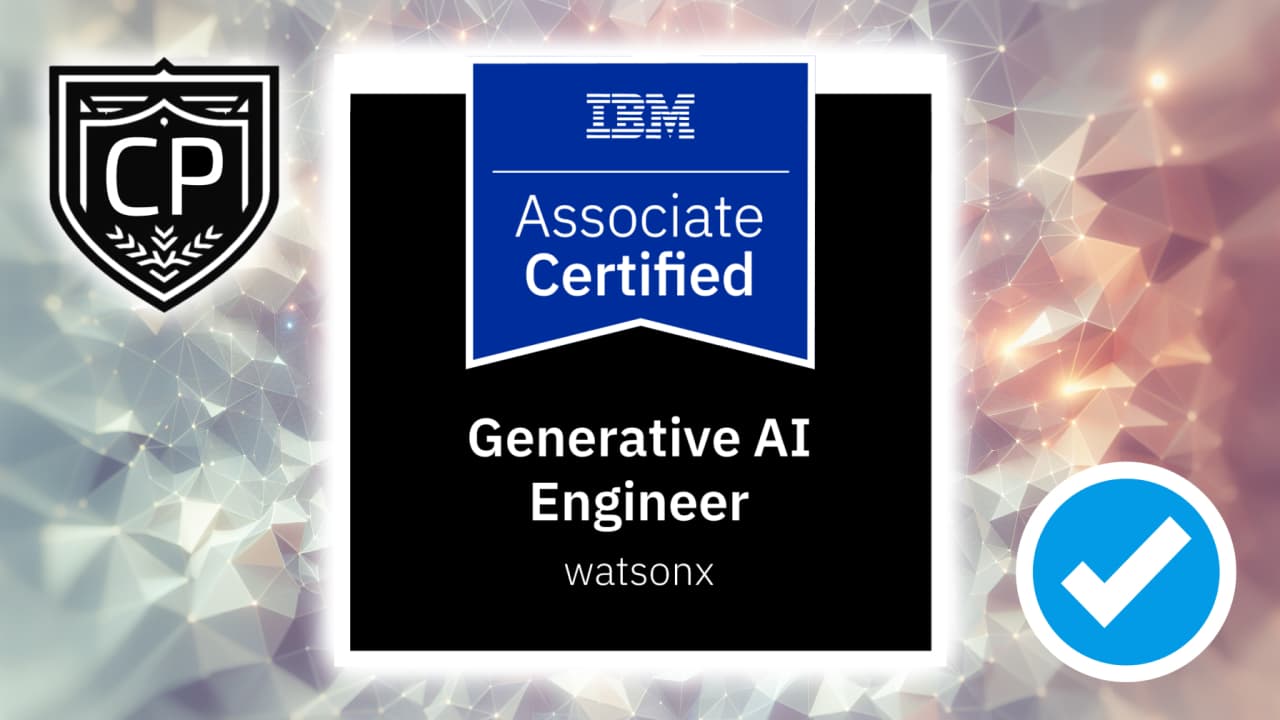
IBM Certified watsonx Generative AI Engineer Associate Quick Facts (2025)

Comprehensive overview of the IBM Certified watsonx Generative AI Engineer – Associate (C1000-185) exam, covering domains, study topics, exam format, costs, passing score, and hands-on watsonx.ai preparation to help you pass and deploy generative AI solutions.

IBM Certified watsonx Generative AI Engineer Associate Quick Facts
5 min read
IBM Certified watsonx Generative AI Engineerwatsonx Generative AI Engineer AssociateC1000-185 examIBM C1000-185watsonx.ai certification
Table of Contents

IBM Certified watsonx Generative AI Engineer Associate Quick Facts

The IBM Certified watsonx Generative AI Engineer Associate certification opens doors to the exciting world of large language models and AI-driven innovation. This guide highlights exactly what to expect from the exam and helps you navigate the skills that define success as an IBM generative AI professional.

How the IBM watsonx Generative AI Engineer Certification Empowers You

The IBM Certified watsonx Generative AI Engineer Associate credential validates your ability to design, develop, tune, deploy, and integrate generative AI systems using watsonx.ai and its related capabilities. It demonstrates practical knowledge of working with large language models (LLMs), building secure and ethical AI applications, and orchestrating data-driven workflows across IBM Cloud services. Ideal for AI practitioners, developers, and data professionals, this certification signifies readiness to shape reliable AI solutions aligned with responsible and governed AI principles.

Exam Domains Covered (Click to expand breakdown)

Exam Domain Breakdown

Domain 1: Analyze and Design a Generative AI Solution (15% of the exam)

1.1. Understand the 5 Capabilities of GenAI models/LLMs

  • Define and describe the five key capabilities of generative AI and large language models (LLMs): Summarization, Classification, Generation - Code, Generation - Translation, Extraction, and Q&A.
  • Review case studies or examples demonstrating each capability.
  • Evaluate the impact of these capabilities in various industries.
  • Discuss potential future developments in LLM capabilities.

1.1 summary: This section introduces the foundational capabilities that define generative AI solutions, covering the core applications that power everything from text summarization and translation to coding and extraction use cases. It emphasizes understanding what each capability contributes to generative workflows and how different task types leverage model strengths. Real-world illustrations reinforce how these functions drive business automation and innovation.

You will also explore how these capabilities scale across various industries, from finance to healthcare, and consider the future direction of model evolution. Mastering this domain helps you communicate the value of LLMs with precision and relate technical features to transformative business applications.

1.2. Articulate the Components in Gen AI Patterns

  • Identify common patterns used in generative AI solutions: Mixture of Experts (MoE), Variational Autoencoders (VaE), Transformer-based models, and Reasoning models.
  • Describe the components that constitute these patterns (input processing, model training, output generation).
  • Analyze real-world examples to illustrate how these patterns are applied.
  • Create diagrammatic representations of generative AI patterns.

1.2 summary: This section focuses on architectural patterns used in generative AI, helping you break down how different model types process and generate data. You will explore each design’s purpose, understanding transformations that optimize both output accuracy and performance within varying contexts.

By examining practical examples, you will gain insight into how these frameworks are applied in modern AI solutions. The emphasis is on visually connecting theory to practice, allowing you to clearly describe model architectures and their operational components.

1.3. Understand the Limitations of GenAI/LLMs

  • List the technical and ethical limitations of generative AI and LLMs.
  • Discuss scenarios where generative AI may produce biased or incorrect outputs.
  • Explore strategies to mitigate these limitations.
  • Evaluate risks associated with deploying generative AI in sensitive or critical environments.

1.3 summary: This section builds awareness of the responsible use of generative AI, emphasizing transparency, bias mitigation, and ethical governance. You will study how model limitations manifest and what frameworks exist to reduce unintended consequences.

Through guided analysis and case studies, you’ll develop strategies to address data quality, fairness, and interpretability. By the end, you will be able to propose design choices that promote safe, high-integrity generative AI applications.

1.4. Understand Use Case and Identify Gen AI Application Opportunities

  • Study industry sectors to identify use cases for generative AI.
  • Conduct needs analysis for applying generative solutions.
  • Propose and evaluate GenAI solutions for specific use cases.
  • Prepare feasibility reports for proposed approaches.

1.4 summary: This section encourages practical exploration through identifying meaningful applications of generative AI across industries. You will learn to connect business problems to technical opportunities, assessing feasibility and design fit.

The focus is on actionable insight—transforming high-level use cases into clear solution plans. The goal is to ensure candidates can align AI capabilities with real-world business outcomes confidently.

1.5. Understand How to Choose the Appropriate Model for a Use Case

  • Analyze requirements to select an appropriate model based on performance, efficiency, and ethics.
  • Evaluate model selection considerations: parameter size, chat versus instruct models, IBM Granite models, and billing classes.
  • Simulate decision-making processes for optimal model selection.

1.5 summary: This section teaches a structured approach to choosing the right models for each type of generative task. You will practice comparing metrics such as model architecture, size, and cost dynamics, aligning them with both business and technical criteria.

It also introduces IBM’s Granite model families, explaining distinctions that affect scalability and efficiency. By mastering these trade-offs, you will ensure model selection that enhances solution performance and impact.

1.6. Articulate the Optimal Model Architecture Based on Use Case

  • Define model architecture and its significance in AI solutions.
  • Examine different architectures and their use cases.
  • Match model architectures with use cases based on needs.
  • Explore agentic architectures.

1.6 summary: This section delves into architectural thinking, helping you match model configurations to diverse problem scenarios. The curriculum covers architectural variants in both traditional and agentic AI systems.

You will gain skills for mapping end-to-end architectures, striking a balance between performance and interpretability. The emphasis is on designing solutions that integrate technical soundness with practical usability.

1.7. Identify and apply various tools and techniques like AI agents, RAG, LangChain, etc.

  • Understand the RAG Pattern and basic search principles.
  • Demonstrate RAG using LangChain.
  • Explore the use of AI agents.

1.7 summary: This section centers around bridging model intelligence with retrieval and reasoning frameworks. You will experiment conceptually with the Retrieval-Augmented Generation (RAG) approach and understand the value of tools like LangChain for context-aware processing.

The content highlights how AI agents coordinate LLM outputs with external data sources for improved results. You will leave with a clear understanding of toolchains that make gen AI systems more capable and responsive.

1.8. Understand security risks associated with LLMs, prompt engineering, prompt, and data

  • Explore security risks associated with inputs: data bias, poisoning, curation, privacy, prompt injection, and leaking.
  • Discuss output risks, including biased or toxic content.
  • Examine secure model governance practices such as guardian models.

1.8 summary: This section equips you with awareness of end-to-end AI security practices. You will evaluate vulnerabilities from data collection to model response handling, learning how to preserve privacy and trust in generative systems.

Through engineered scenarios, you’ll understand mitigation techniques that prevent prompt leakage, bias propagation, and misuse. The focus is on designing secure AI workflows aligned with best practices in data ethics and model safety.

Domain 2: Prompt Engineering (16% of the exam)

2.1. Differentiate between zero-shot and few-shot prompting

  • Introduce zero-shot and few-shot prompting.
  • Practice with examples for each method.

2.1 summary: This section introduces the foundational prompt formats that drive generative results. You will learn how to select and design prompts that yield effective responses without specific training data.

By experimenting conceptually with each prompting style, you will strengthen your skill in tailoring model inputs to achieve consistent, relevant outputs across tasks.

2.2. Design Prompts based on use case

  • Choose the right model for a use case.
  • Create prompt interactions for conversation and translation contexts.

2.2 summary: This section expands your ability to design prompts aligned to specific objectives. You will examine conversational and translation examples that demonstrate practical application.

The emphasis is on designing for intent clarity and accuracy. By refining prompt composition, you ensure outcomes that align with the model’s contextual understanding.

2.3. Generate Prompt Templates

  • Introduce prompt templates and their evaluation.
  • Create, deploy, and track templates within environments.

2.3 summary: Here, you’ll deepen your understanding of prompt reuse through templating. This practice emphasizes structure, maintainability, and metrics-driven improvement.

It also explores deployment strategies that connect prompt templates directly to scalable AI workflows. The takeaway is confidence in managing prompt lifecycle across development environments.

2.4. Determine the best model parameters for each GenAI prompt

  • Understand decoding strategies: greedy vs sampling.
  • Learn about parameters like random seed, repetition penalty, stopping criteria, token limits.

2.4 summary: This section unpacks how decoding parameters influence the behavior and creativity of generated text. You’ll analyze how each setting changes tone, length, and precision.

Hands-on understanding allows you to calibrate balance between structure and flexibility, enabling professional-grade control over generative outputs.

2.5. Describe the benefits of using prompt variables

  • Define prompt variables.
  • Identify optimal static text to replace with variables.
  • Summarize advantages of reusable prompts.

2.5 summary: This section teaches parameterization for prompt optimization, establishing a framework for reusability and efficiency. You’ll discover how prompt variables serve as placeholders for dynamic context.

It emphasizes the operational value of scalability when prompts adapt on demand—empowering developers to build flexible, maintainable generative applications.

2.6. Describe the benefits of Prompt Lab

  • Explain Chat, Structured, and Freeform Prompt Lab options.
  • Demonstrate prompt creation and use.

2.6 summary: You’ll explore IBM’s Prompt Lab capabilities for managing and visualizing prompt workflows. The focus is on hands-on experimentation and best practices for iterative refinement.

By mastering these tools conceptually, you gain insight into collaborative prompt building, tracking, and optimization across projects.

2.7. Controlling model parameters

  • Explain decoding processes and sampling principles.
  • Manage parameters including temperature, top K, top P, and stopping criteria.

2.7 summary: This section emphasizes the art of generation control through parameter adjustment. You’ll learn how to implement fine-grained control for tone, randomness, and coherence.

It helps you think like a model tuner—balancing parameters to achieve the best possible generative performance with predictable, high-quality results.

2.8. Articulate model risks

  • Describe hallucinations, bias, and PII risks.
  • Evaluate strategies such as HAP filtering and PII filters.
  • Debate approaches to reduce harm and bias.

2.8 summary: This section examines how to identify and manage potential issues in generated outputs. You’ll discuss ethical filters and responsible configuration methods that protect users and organizations.

Your outcome from this section is a framework for recognizing content risks while applying practical, technical methods to ensure safe and fair AI communication.

Domain 3: Fine-tuning (31% of the exam)

3.1. Understand the difference between hard and soft prompts

  • Differentiate based on human vs AI design, readability, and explainability.
  • Discuss advantages and tradeoffs in performance and interpretability.

3.1 summary: This section introduces techniques that drive personalization in generative models. You’ll compare manually built (hard) and learned (soft) prompts, discovering how each affects explainability and efficiency.

The balance between control and automation is explored to help you tailor fine-tuning strategies for specific outcomes and environments.

3.2. Reconstruct prompts to reduce the cost of using GenAI models

  • Manage tokens within templates.
  • Detect inefficiencies and reduce generation cost with parameters and limits.

3.2 summary: Cost efficiency is the theme here—learning to identify how token consumption impacts production usage. You’ll explore design choices that influence resource optimization.

By mastering prompt redesign and parameter control, you can deliver solutions that balance creativity, cost, and speed, elevating both user experience and operational savings.

3.3. Plan for Data elements for application usage

  • Add data to watsonx.ai projects.
  • Inspect and validate data elements using integrated tools like Data Refinery.

3.3 summary: This section focuses on preparing high-quality data for fine-tuning initiatives. You’ll review data validation, identify refinement workflows, and understand the relationship between dataset quality and model output.

Practical insight is built around structured planning for data readiness. It underscores how foundational preparation accelerates tuning success.

3.4. Articulate model quantization techniques

  • Understand quantization benefits and tradeoffs in precision and computational cost.
  • Discuss techniques for applying quantization effectively.

3.4 summary: Quantization is unpacked as an essential optimization process in large-model adaptation. You’ll understand its impact on computational performance without compromising accuracy.

By analyzing scenarios where reduced precision produces efficiency gains, you will align model performance to scalable deployment goals.

3.5. LoRA

  • Explore the LoRA technique for fine-tuning.

3.5 summary: This concise but important section highlights Low-Rank Adaptation (LoRA) as a modern fine-tuning approach that enables parameter-efficient adaptations. You’ll review its core concepts and where it fits in the Watsonx AI lifecycle.

By grasping LoRA essentials, you establish a foundation for tuning at scale with minimal retraining overhead.

3.6. Prepare the dataset for training

  • Summarize taxonomy tree-based data curation.
  • Generate synthetic data using InstructLab methodology.

3.6 summary: This section combines data preparation and augmentation strategies to enhance model adaptability. You’ll explore taxonomy frameworks and synthetic data generation principles.

The key is understanding how curated datasets improve generalization. Through structured curation, you can ensure models learn balanced and relevant patterns.

3.7. Customize LLMs with InstructLab

  • Explain InstructLab components, from data curation to iterative tuning.
  • Describe Knowledge and Skill tuning workflows.

3.7 summary: You will dive deep into IBM’s InstructLab process and its iterative nature for LLM alignment. The learning goal is to demystify the cycle of large-scale data-driven improvements.

Realistic examples support understanding of how Knowledge and Skill tuning refine performance metrics, enabling continuous improvement across deployments.

3.8. Generate synthetic data using the User Interface

  • Discuss options for existing or custom schemas.
  • Review anonymization, privacy settings, and statistical methods like Kolmogorov-Smirnov and Anderson-Darling.
  • Introduce differential privacy concepts.

3.8 summary: This section showcases hands-on ways to create compliant, privacy-safe synthetic data within watsonx tools. You’ll explore algorithmic approaches to generate realistic yet secure datasets.

The module builds your understanding of privacy parameters, data size planning, and bias reduction strategies, ensuring reliable datasets for model training and testing.

Domain 4: Retrieval-Augmented Generation (RAG) (17% of the exam)

4.1. Describe what embeddings are in Context of GenAI

  • Understand text embeddings and types of embedding models.

4.1 summary: You begin by defining embeddings as the bridge between language and computation. The section outlines how vector representations make unstructured data searchable.

Practical understanding centers on IBM and third-party embedding model choices, revealing how high-quality embeddings transform performance in generative workflows.

4.2. Generate vector embeddings utilizing models

  • Convert text into embeddings.
  • Identify API prerequisites and explore vector database options.

4.2 summary: This section focuses on operational steps for embedding generation and storage. You’ll examine the functional integration between text and vector systems.

By studying example scenarios, you gain clarity on credentials, project configuration, and the strengths of specialized versus extended vector databases.

4.3. Describe when to use a vector database

  • Define retrievers and compare retrieval types using vector databases.
  • Explore use cases involving watsonx Discovery and code retrieval APIs.

4.3 summary: You’ll explore retrievers as essential tools for efficient context recall. This section compares embedded and static vector databases across scenarios requiring precision or speed.

Through applied reasoning, you will understand optimal retriever configurations that enhance information gathering in AI pipelines.

4.4. Develop using libraries and tools

  • Understand RAG concepts and implementations using frameworks like LangChain and LlamaIndex.
  • Discuss advanced approaches such as Agentic RAG and AutoRAG.

4.4 summary: This section concludes by exploring RAG implementations, highlighting how to combine model inference with powerful retrieval systems. You’ll conceptually build links between components like LangChain and watsonx.ai.

Experimental exploration reinforces architectures where real-time knowledge access boosts accuracy and responsiveness in generative AI applications.

Domain 5: Deployment (13% of the exam)

5.1. Plan a deployment based on client needs

  • Define the lifecycle of prompt templates and understand governance roles.
  • Evaluate AI governance requirements like model performance and explainability.

5.1 summary: This section offers the blueprint for preparing AI assets for production. You’ll design strategies that align project delivery with business and compliance standards.

It encourages viewing deployment from both a technical and governance lens, ensuring long-term maintenance and transparency in deployed AI solutions.

5.2. Deploy AI Assets

  • Highlight benefits of deployment spaces and endpoints.
  • Discuss prompting changes for applications in production.

5.2 summary: You’ll identify how deployment spaces simplify managing multi-environment pipelines. Topics include version control, endpoint management, and scalability best practices.

By conceptualizing these operational tools, you’ll be ready to deploy reliable, maintainable generative AI assets seamlessly across enterprise systems.

5.3. Deploy a custom model

  • Understand watsonx and foundation model requirements.
  • Explain application access to custom models.

5.3 summary: This section ensures you can transform custom fine-tuned models into accessible solutions. It covers integration and credentialing essentials for production use.

Through theoretical and system-level understanding, you’ll recognize what is needed to scale localized or domain-specific models efficiently.

5.4. High-level architecture for deployment options

  • Learn about versioning, application changes upon version updates, and testing new prompt versions.
  • Review model gateway integration.

5.4 summary: This section takes a holistic approach to version control and robust deployment management. Participants examine approaches for testing prompt versions and integrating new model releases safely.

Architectural conversations highlight reliability and continuity strategies that ensure AI systems evolve without interrupting service quality.

5.5. Plan the deployment of prompts for versioning

  • Analyze managed service options and deployment patterns like RAG, Summarization, and Q&A.
  • Review corpus management, pipeline automation, and endpoint security.

5.5 summary: This section ties deployment strategy directly to real-world generative AI patterns. You’ll explore methods for managing corpora, tuning data repositories, and securing API endpoints.

It brings together scalability, stability, and governance considerations that empower efficient versioned deployment of prompt-driven solutions.

Domain 6: watsonx - Integration and Model Orchestration (8% of the exam)

6.1. Integrate watsonx.ai with Other Services

  • Integrate watsonx.ai with IBM Cloud services and external APIs.
  • Configure connections and governance integration.

6.1 summary: This section explains integration across IBM’s AI ecosystem, focusing on interoperability and service orchestration. You will explore how watsonx.ai interacts with governance layers and external applications.

It empowers you to design interconnected solutions, creating a seamless flow between AI generation, governance, and deployment services.

6.2. Orchestrate AI Workflows

  • Design end-to-end AI workflows integrating multiple tasks and automation tools.
  • Implement error handling, scheduling, and adaptive branching.

6.2 summary: You’ll gain a clear view of workflow orchestration as it applies to complex gen AI applications. The section introduces methodologies for sequencing AI tasks using tools like LangChain.

By studying troubleshooting and performance optimization techniques, you develop intuition for maintaining reliable and efficient automation pipelines.

6.3. Understand real-world Integration Scenarios

  • Design comprehensive solutions integrating watsonx.ai, IBM Cloud, and external systems.
  • Develop and validate end-to-end integration.

6.3 summary: This section bridges design with implementation, guiding you from architectural thinking to practical deployment. Topics include data pipelines, API connectivity, and validation processes.

The outcome is a strong capability for ensuring that all components communicate effectively with predictable data flow and governance alignment.

6.4. Develop LLM based applications with LangChain

  • Explain core LangChain concepts like chains, agents, tools, and memory.
  • Demonstrate the creation and customization of AI-driven chains and agents.

6.4 summary: The final section celebrates how LangChain enables modular generative AI development. You’ll learn conceptual steps for building multi-component agents that enhance reasoning and contextual understanding.

By understanding its extensibility, candidates will be prepared to design and adapt solutions that leverage LangChain for scalable, high-performing AI experiences.

Who Should Pursue the IBM Certified watsonx Generative AI Engineer – Associate Certification?

This certification is perfect for professionals excited to work at the intersection of artificial intelligence, data science, and enterprise innovation. If you want to design, develop, and deploy generative AI solutions using IBM watsonx.ai, this certification is for you. It’s ideal for:

  • Data scientists and AI engineers beginning their generative AI journey
  • Software developers expanding into LLM-based AI solution design
  • Technical consultants integrating generative AI into business solutions
  • Students and professionals pursuing careers in AI application development

Earning this credential demonstrates your ability to apply cutting-edge AI responsibly and effectively across enterprise environments.

What Career Paths Can the IBM watsonx Generative AI Engineer – Associate Open Up?

This certification can be a door to exciting, future-proof career paths. With hands-on knowledge of watsonx.ai and large language models (LLMs), you’ll be prepared for roles such as:

  • Generative AI Engineer or AI Solutions Developer
  • Prompt Engineer specializing in prompt tuning and optimization
  • AI Consultant helping clients build and deploy AI solutions
  • Data Engineer focused on integrating retrieval-augmented generation (RAG) systems
  • AI Application Architect designing end-to-end generative systems

The certification signals to employers that you understand both the technical and strategic aspects of generative AI deployment.

What Is Covered in the IBM watsonx Generative AI Engineer v1 (Exam C1000-185)?

The IBM Certified watsonx Generative AI Engineer – Associate (C1000-185) exam measures your ability to design, implement, fine-tune, and deploy generative AI solutions within IBM watsonx.ai. You’ll demonstrate understanding of prompt engineering, model tuning, retrieval-augmented generation, and AI solution integration.

This certification focuses on practical knowledge—everything from customizing LLMs using InstructLab to orchestrating AI workflows with LangChain. You’ll learn how to align models with business use cases while maintaining responsible AI practices.

How Much Does the IBM watsonx Generative AI Engineer C1000-185 Exam Cost?

The exam cost is $200 USD, which grants you access to the official IBM certification exam through Pearson VUE. This investment certifies your expertise in generative AI engineering and gives you an industry-recognized credential that validates your ability to design and deploy real-world AI systems.

How Long Is the IBM C1000-185 Exam and How Many Questions Are There?

The exam includes 62 questions, and you’ll have 90 minutes to complete it. Most questions are multiple-choice or multi-select, and they test both conceptual understanding and applied reasoning. Candidates are expected to draw on hands-on experience within IBM watsonx.ai Studio.

What’s the Passing Score for the IBM Certified watsonx Generative AI Engineer Exam?

To earn your certification, you must correctly answer at least 44 out of 62 questions, achieving a score of 71% or higher. The exam is balanced across key domains, and your overall score determines your success. IBM uses fair and methodical scoring to ensure that certified engineers demonstrate both technical proficiency and solid AI understanding.

What Language Is the Exam Offered In?

Currently, the IBM watsonx Generative AI Engineer – Associate exam is available in English. As IBM expands this certification globally, additional languages may be added in the future to support broader accessibility.

What Topics and Domains are Included on the Exam?

The exam is built around six main content domains, each representing a vital area of practical knowledge:

  1. Analyze and Design a Generative AI Solution (15%) – Understand LLM capabilities, business use cases, and architecture patterns
  2. Prompt Engineering (16%) – Craft effective prompts using zero-shot, few-shot, and structured techniques
  3. Fine-Tuning (31%) – Apply methods like InstructLab, LoRA, and quantization to customize models efficiently
  4. Retrieval-Augmented Generation (17%) – Implement embeddings, vector databases, and RAG workflows
  5. Deployment (13%) – Deploy AI assets, models, and governed prompts to production
  6. watsonx.ai Integration and Model Orchestration (8%) – Combine IBM Cloud services and automation with LangChain

Together, these areas validate your ability to design, build, and operationalize generative AI systems.

Is There Any Work Experience or Educational Background Required?

There are no strict prerequisites, but IBM recommends 6 to 12 months of practical experience with watsonx.ai or similar generative AI platforms. Familiarity with Python, data science, and basic AI modeling concepts will significantly enhance your learning and exam readiness.

What Skills Should You Develop Before Attempting the Exam?

To be confident during the exam, you should practice and understand:

  • Working with prompt engineering and prompt tuning
  • Creating and evaluating fine-tuned LLMs using InstructLab
  • Understanding RAG architectures and vector databases
  • Deploying AI solutions within watsonx.ai Studio
  • Integrating with services like Watson Assistant and Watson Discovery
  • Following AI governance principles, bias mitigation, and data security best practices

Hands-on work within watsonx.ai is the best way to reinforce these core skills.

Are There Any Practice Tests or Preparation Resources Available?

Absolutely. To test your knowledge under realistic exam conditions, try the best IBM watsonx Generative AI Engineer Associate practice exams that mirror the actual test format and provide detailed explanations for every question. These practice exams are highly effective in boosting confidence, improving time management, and identifying areas to focus on before the real assessment.

IBM offers multiple learning options to get you exam-ready:

  • IBM watsonx.ai official learning paths on generative AI
  • Certification prep sessions explaining each exam domain
  • Hands-on projects using generative AI tools and InstructLab workflows
  • Documentation and tutorials on watsonx.ai features and governance

Combining IBM’s structured study paths with example-based experimentation ensures you understand both concepts and practical implementation.

What Are the Exam Format and Question Types?

The exam includes multiple-choice and multiple-select questions, often scenario-based to reflect real-world engineering challenges. You’ll analyze given situations and determine the best solution design, deployment strategy, or integration method within watsonx.ai.

What Level of Difficulty Should You Expect?

The IBM watsonx Associate exam is designed for those aiming to demonstrate foundational yet applied expertise. It tests understanding—not just memorization—of how generative AI capabilities solve enterprise problems. The exam is approachable for motivated learners who complete hands-on preparation.

How Is the IBM Certified watsonx Generative AI Engineer Certification Structured in IBM’s Overall Track?

This certification is part of the broader IBM Watsonx Certification Path. The Associate level validates foundational, hands-on proficiency. Over time, you can advance to higher-level credentials as IBM introduces professional and specialist certifications for deeper expertise across model governance, automation, and AI lifecycle management.

How Long Is the Certification Valid and How Can You Renew It?

The certification remains valid for three years from the date you pass the exam. IBM periodically updates certifications to reflect evolving product capabilities. To renew, you can retake the latest version of the exam or pursue a higher-level watsonx certification, which automatically extends your credential status.

Why Is This Certification Worth Earning?

Organizations are rapidly integrating generative AI—and they need skilled professionals who can do it responsibly. As an IBM Certified watsonx Generative AI Engineer, you’ll hold a credential backed by one of the most respected names in AI and cloud computing. It highlights your expertise in deploying secure, ethical, and high-impact generative AI solutions.

How Does This Certification Compare to Other AI Credentials?

While other AI certifications emphasize theory or vendor-neutral concepts, IBM’s credential is application-driven—centered on the watsonx ecosystem. You get tangible, actionable experience implementing generative AI workflows. That makes this certification highly appealing to employers seeking practical skills, not just academic knowledge.

What Are the Common Mistakes Candidates Should Avoid?

To stay focused and effective:

  • Don’t rely solely on memorization; practice using watsonx.ai hands-on
  • Pay attention to model security and ethical considerations—these are tested concepts
  • Ensure you understand InstructLab’s data curation and tuning workflows
  • Review how LangChain aids complex orchestration tasks

Balanced preparation ensures success and a strong grasp of responsible AI implementation.

How and Where Can You Register for the IBM Certified watsonx Generative AI Engineer – Associate Exam?

You can register online through Pearson VUE after confirming your readiness with IBM’s certification portal. Visit the official IBM Certified watsonx Generative AI Engineer – Associate certification page for full details on scheduling, testing options, and candidate resources. You can choose either an online proctored session or an in-person test at an approved testing center.


Earning your IBM Certified watsonx Generative AI Engineer – Associate certification is an empowering milestone in your AI career. With focused study, practical experience, and the right learning resources, you'll be prepared to shape the future of generative AI innovation within any organization.
Share this article
IBM Certified watsonx Generative AI Engineer Associate Mobile Display
Free Practice Exam:IBM Certified watsonx Generative AI Engineer Associate
LearnMore