Table of Contents
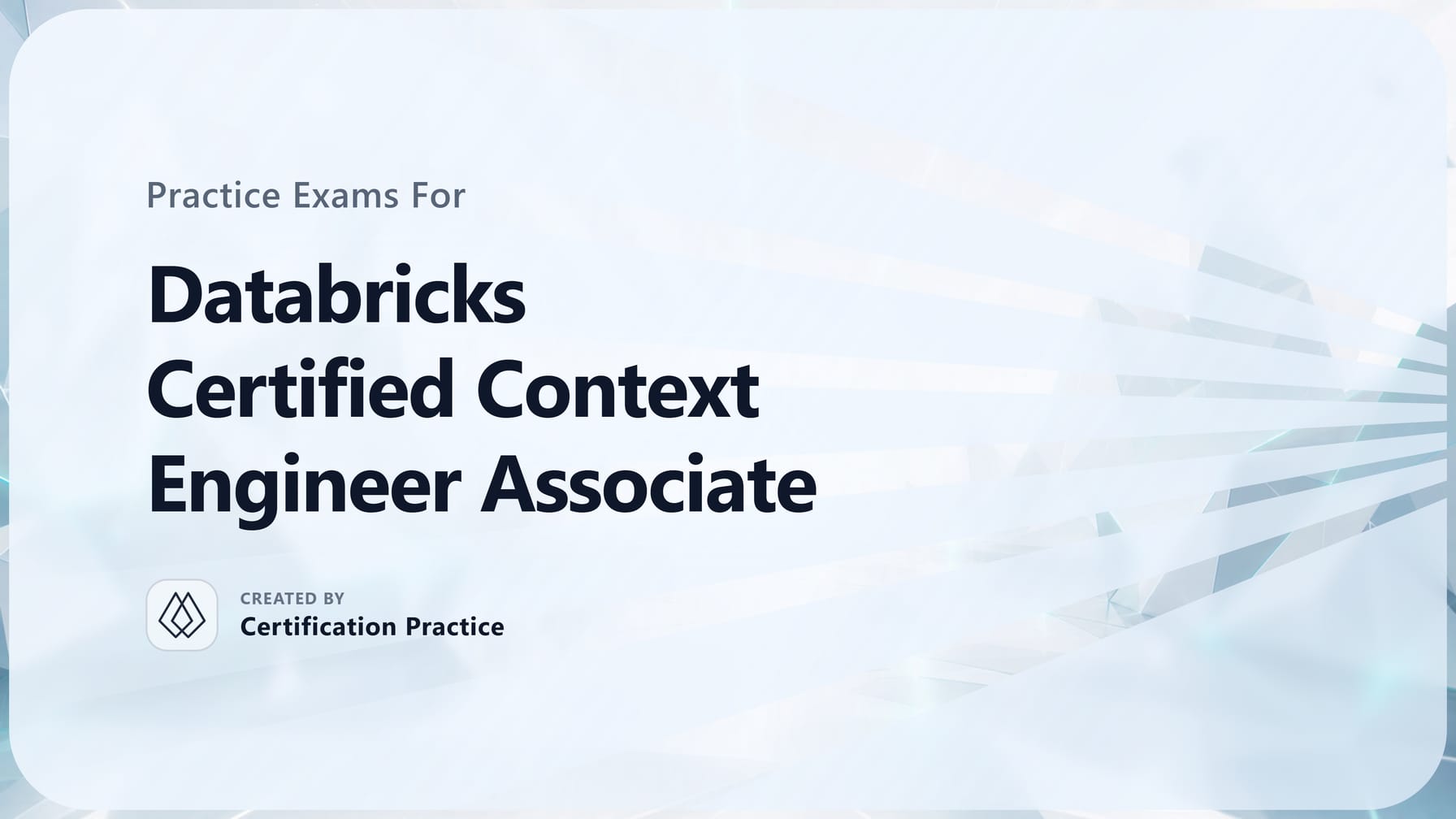
Databricks Certified Context Engineer Associate Quick Facts
The Databricks Certified Context Engineer Associate exam is a powerful credential for professionals ready to master the art of managing agent context on the Databricks platform. This overview will guide you through everything you need to know about the exam, helping you confidently showcase your expertise in this exciting and rapidly evolving field.
What Does the Databricks Certified Context Engineer Associate Certification Validate?
The Databricks Certified Context Engineer Associate certification validates your ability to design, manage, and optimize context for AI agents operating on the Databricks platform. It confirms that you understand how to build agents that reason clearly, retrieve the right information at the right time, and maintain coherent behavior across long and complex interactions.
This certification is ideal for data engineers, ML practitioners, and AI developers who work with Databricks tools like Unity Catalog, Lakebase, MLflow 3, and the Mosaic AI Platform. Whether you're building RAG pipelines, configuring Genie spaces, designing multi-agent workflows, or tuning compaction strategies, this credential demonstrates that you can apply context engineering best practices to real-world agent deployments.
Earning this certification shows employers and teams that you have a structured, practical understanding of how context flows through agent systems on Databricks, and that you can make smart, cost-effective decisions about what enters the model's attention at every stage of an agent's lifecycle.
Who Should Consider the Databricks Certified Context Engineer Associate Certification?
The Databricks Certified Context Engineer Associate certification is perfect for AI engineers, ML practitioners, and developers working with agentic systems on Databricks. If you're building retrieval-augmented generation (RAG) pipelines, designing multi-agent workflows, or managing the information that LLMs receive at inference time, this credential validates your specialized skill set. It's especially valuable for professionals working with Agent Bricks, MCP, Lakebase, and Unity Catalog in production AI environments.
This certification also benefits teams and organizations adopting agentic AI. If your company is deploying Databricks-based agents and wants to ensure they're reliable, efficient, and well-governed, having a certified Context Engineer on staff demonstrates a commitment to best practices. Even if you're relatively new to context engineering but have hands-on experience with Databricks, this is a fantastic way to formalize your knowledge.
What Career Opportunities Open Up with This Certification?
This certification positions you as a specialist in a rapidly growing field. Context engineering is essential for production AI systems, and certified professionals are in demand for roles like:
- AI Engineer or Generative AI Engineer
- Agent Systems Developer
- ML Platform Engineer
- Solutions Architect (AI/ML Focus)
- Data Engineer with GenAI Specialization
Many organizations are actively building agentic applications on Databricks, and they need people who understand how to design memory, retrieval, and governance into these systems. This certification signals that you can build agents that work reliably at scale, making you a strong candidate for senior technical roles or consulting opportunities.
How Much Does the Databricks Certified Context Engineer Associate Exam Cost?
The registration fee for this exam is $200 USD. This is a standard price point for associate-level certifications in the Databricks ecosystem. Keep in mind that additional taxes or currency conversion fees may apply depending on your location and payment method.
Databricks occasionally offers discounts or vouchers through training programs, events, or partner promotions. If you’ve completed Databricks Academy courses or attended a Data + AI Summit, check whether you have access to any special pricing. The investment is well worth it for the career advancement and technical validation it provides.
How Many Questions Are on the Exam?
The exam includes 45 scored questions, all in multiple-choice or multiple-selection format. In addition to these, Databricks may include unscored experimental questions to test future content, but these don’t affect your final score. You won’t be able to tell which questions are scored and which are experimental, so treat every question with equal focus.
The mix of question types means you’ll need to read carefully and sometimes select more than one correct answer. This format tests both your conceptual understanding and your ability to apply context engineering principles to real-world Databricks scenarios.
How Much Time Do I Get for the Exam?
You’ll have 90 minutes to complete the exam. That’s an average of two minutes per question, which is usually enough if you’re well-prepared. Some questions may be quick lookups, while others might require you to analyze a scenario or trace, so pacing yourself is key.
It’s a good idea to flag questions you’re unsure about and return to them at the end. Since all questions are weighted equally, don’t spend too much time on any single one. With practice, you’ll develop a rhythm that lets you finish comfortably within the time limit.
What Languages Is the Exam Available In?
Currently, the Databricks Certified Context Engineer Associate exam is offered in English. If English isn’t your first language, you may request additional time as an accommodation, but the exam content and interface will be in English.
Databricks may expand language options in the future as demand grows, so it’s worth checking the official certification page for updates. For now, ensure you’re comfortable reading technical English, especially around agent systems, retrieval, and governance topics.
What’s the Passing Score for the Context Engineer Associate Exam?
The passing score for this exam is 70%. Databricks uses a scaled scoring model, meaning your raw score is converted to a standardized scale to account for slight variations in exam difficulty across different versions.
You don’t need to pass each domain individually. The exam uses a compensatory scoring model, so a strong performance in one area can offset a weaker one, as long as your overall score meets or exceeds the 70% threshold. Focus on being well-rounded across all topics, but don’t panic if one domain feels weaker than others.
Is This Exam Difficult?
This is an associate-level exam, but it covers specialized, technical material. If you have hands-on experience building agents on Databricks and understand context engineering concepts like memory, retrieval, and compaction, you’ll find the content approachable. The exam is designed to validate practical skills, not just theory.
That said, the breadth of topics, from Genie configuration to MCP tool design to Lakebase memory, means you’ll want structured preparation. Many candidates find that using realistic practice exams, like the ones available at this helpful Databricks Certified Context Engineer Associate practice test resource, makes a big difference in their confidence and readiness.
What Domains Are Covered on the Databricks Certified Context Engineer Associate Exam?
The exam blueprint is divided into seven domains, each with a specific weighting:
- Knowledge Retrieval and Genie Configuration
- Memory Architecture with Lakebase and MLflow
- Foundations of Context Engineering
- Tool Design, MCP, and Agent Context
- Multi-Agent and Long-Horizon Task Design
- Context Compression and Compaction
- System Prompt and Instruction Design
Each domain tests your ability to apply context engineering principles using Databricks tools. The heaviest emphasis is on retrieval and memory, reflecting how central those are to production agent systems.
Are There Any Prerequisites for This Certification?
There are no formal prerequisites. Databricks recommends 6+ months of hands-on experience performing context engineering tasks, but you can register and take the exam without any prior certifications or mandatory training.
That said, you’ll have a much better experience if you’ve worked with Databricks Agent Bricks, AI Search, Lakebase, MLflow 3, and Unity Catalog. Familiarity with Python, SQL, and LLM concepts like context windows and prompt engineering will also help you move through the material more smoothly.
What Knowledge Areas Should I Focus On?
To prepare effectively, concentrate on these core areas:
- Context Engineering Fundamentals
- Retrieval and Genie
- Memory with Lakebase and MLflow
- Tools, MCP, and Agent Context
- Compaction and Compression
- Multi-Agent and Long-Horizon Workflows
Hands-on practice with these topics in a Databricks workspace will reinforce your learning far better than reading alone.
What Version of the Exam Should I Take?
The current version of the exam is the one that launched in mid-2026. Always use study materials and practice tests that align with the latest exam guide, as Databricks updates content to reflect new features and best practices.
Before your exam date, double-check the exam guide PDF to confirm you’re studying the most current objectives. Databricks typically announces version changes well in advance, so you’ll have time to adjust if needed.
How Long Is the Certification Valid?
Your Databricks Certified Context Engineer Associate certification is valid for 2 years from the date you pass. After that, you’ll need to recertify by passing the current version of the exam again.
Recertification ensures your skills stay up to date as Databricks evolves its platform. Since agentic AI is a fast-moving field, this two-year cycle helps maintain the value and relevance of your credential.
What Should I Do After Earning This Certification?
Once certified, you can deepen your expertise by pursuing more advanced Databricks certifications, such as the Generative AI Engineer Associate or Machine Learning Professional. You might also explore specialized training in agent deployment, monitoring, or governance.
Many certified context engineers go on to lead AI architecture decisions, mentor teams, or contribute to open-source agent frameworks. This certification is a strong foundation for becoming a recognized expert in agentic AI on Databricks.
Where Can I Take the Exam?
You can take the exam either:
- Online with remote proctoring, or
- In person at a Pearson VUE test center
Both options are secure and proctored. Online testing requires a quiet, private space, a reliable internet connection, and a webcam. In-person testing may be preferable if you want a distraction-free environment or have concerns about your home setup.
How Do I Register for the Exam?
To register:
- Visit the official Databricks Certified Context Engineer Associate certification page
- Click the registration link to be directed to the exam delivery platform
- Choose your preferred testing method (online or in-person)
- Select a date and time that works for you
- Complete payment and receive your confirmation
Make sure to run a system check if you’re testing online, and review the exam guide one more time before your scheduled date.
How Can I Best Prepare for the Exam?
Databricks recommends a combination of self-paced training, documentation review, and hands-on practice. Start with the Generative AI Engineering with Databricks and Data Engineering with Databricks learning paths in Databricks Academy. These courses cover agent building, retrieval, memory, and governance in depth.
Complement your training with real-world practice in a Databricks workspace. Build a small agent, configure a Genie space, experiment with Lakebase memory, and use MLflow to evaluate your results. The more you apply these concepts, the more natural they’ll feel on exam day.
What Are Common Mistakes to Avoid?
Many candidates underestimate the exam’s practical focus. Avoid these pitfalls:
- Only reading documentation without building anything in Databricks
- Ignoring lower-weighted domains, since every point counts toward your 70%
- Skipping practice exams, which help you get used to question phrasing and timing
- Not reviewing the exam guide for updates before your test date
A balanced, hands-on approach will serve you much better than last-minute cramming.
Is the Exam Open Book or Are Test Aids Allowed?
No test aids are allowed during the exam. It’s a closed-book, proctored assessment, whether you take it online or in person. You won’t have access to notes, documentation, or external websites.
This policy ensures the certification maintains its integrity and value. It also means your preparation should focus on internalizing concepts and being able to apply them from memory in scenario-based questions.
Can I Use SQL or Python on the Exam?
All code shown in the exam will be in Python, and some data manipulation or workflow logic may be shown in SQL. You won’t be asked to write code from scratch, but you will need to read and interpret it to answer questions.
For example, you might see a Python snippet that configures a checkpointer or a SQL query used in a Genie space. Being comfortable with both languages will help you quickly understand what’s being asked and choose the correct answer.
The Databricks Certified Context Engineer Associate certification is a valuable credential for anyone building the next generation of AI agents on Databricks. With focused preparation and hands-on experience, you’ll be well on your way to passing and advancing your career in this exciting field.